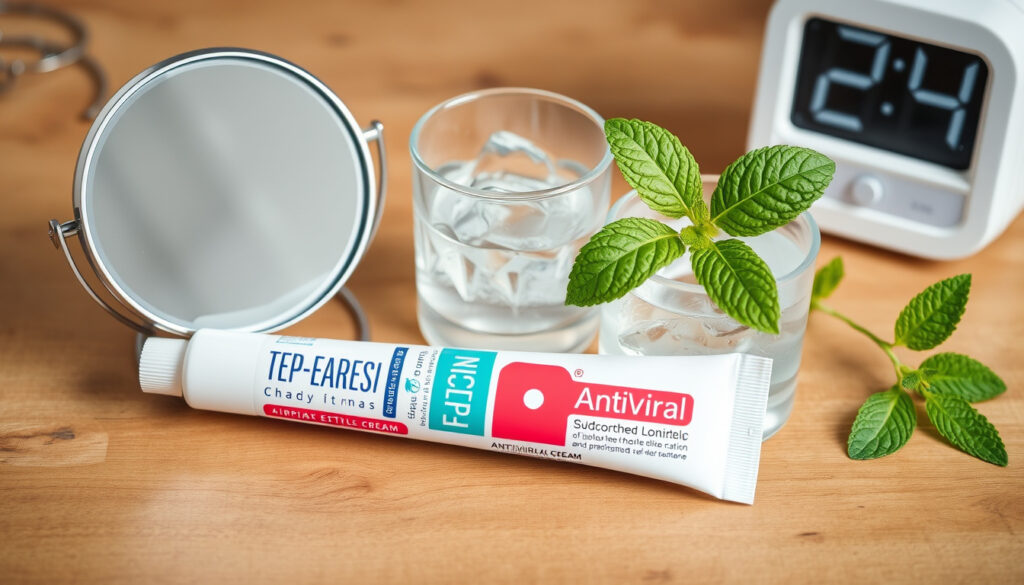
How to Get Rid of a Cold Sore in 24 Hours: Fast Remedies
You feel that familiar tingle on your lip, and your mind races: can I really get rid of a cold sore in 24 hours? The honest answer is maybe, if you act fast with the right combination of prescription antivirals and smart home care.
Adults carrying HSV-1: 50–80% (CDC (U.S. public health agency)) ·
Typical cold sore duration: 7–10 days ·
Antiviral efficacy window: Within 48 hours of onset ·
Contagious period: Until sore is fully crusted ·
Recurrence rate: Up to 40% of infected individuals experience frequent outbreaks
Quick snapshot
- Apply antiviral cream at first tingle (NHS (UK health authority))
- Place ice pack wrapped in towel for 10 min (Mayo Clinic (nonprofit medical center))
- Avoid touching or picking the sore (Health Service Executive Ireland (national health service))
- Prescription antivirals (acyclovir, valacyclovir) (American Family Physician (clinical review))
- OTC docosanol cream (Abreva) (Oral Diseases (peer-reviewed journal))
- GP-consult for recurrent cases (American Family Physician (clinical review))
- Ice packs for pain and swelling (Mayo Clinic (nonprofit medical center)) (PubMed (peer-reviewed research))
- Lysine supplements (3 g/day) (PubMed (peer-reviewed research))
- Hydrocolloid patches to cover sore (PubMed (peer-reviewed research))
- Sunscreen on lips (NHS (UK health authority))
- Stress management (Mayo Clinic (nonprofit medical center))
- Avoid triggers like illness or fatigue
Five key facts set the stage for any treatment plan.
| Label | Value |
|---|---|
| Cause | Herpes simplex virus type 1 (HSV-1) |
| Incubation period | 2–12 days after exposure |
| Typical healing time without treatment | 7–10 days |
| Contagious until | Sore is fully crusted and healed |
| First-line treatment | Topical or oral antivirals started within 48 hours |
What kills cold sores the fastest?
Prescription antiviral medications (acyclovir, valacyclovir)
- Oral antivirals are most effective when started at the first sign of symptoms or during the prodromal phase, before the blister fully develops (American Family Physician (clinical review))
- Valacyclovir 2 g twice daily for one day is a commonly recommended episodic oral regimen (DrOracle (clinical resource))
The implication: prescription tablets can shorten healing time by 1–2 days, but you need a doctor’s script.
Over-the-counter docosanol cream
- Topical docosanol 10% cream is FDA-approved for cold sores and works best when applied at the earliest stage (Oral Diseases (peer-reviewed journal))
Why this matters: OTC options are accessible, but they are less potent than prescription antivirals for speeding healing within 24 hours.
Combining antivirals with ice therapy
- Mayo Clinic recommends a cold, damp cloth to ease symptoms and help remove crusting (Mayo Clinic (nonprofit medical center))
The catch: ice reduces inflammation and pain but does not kill the virus — it’s a supportive, not curative, measure.
For those with frequent outbreaks, asking your GP for a standing prescription of valacyclovir or famciclovir can mean the difference between a full-blown sore and a barely-there bump.
The implication: early treatment is key.
What home remedies help cold sores?
Ice pack application technique
- Apply ice wrapped in a towel for 10 minutes at a time to reduce swelling and pain (Mayo Clinic (nonprofit medical center))
What this means: ice won’t shorten the duration, but it makes the first 24 hours more bearable.
Lysine supplements and dietary sources
- Lysine may reduce recurrence frequency per some studies, but evidence is mixed (PubMed (peer-reviewed research))
The trade-off: taking 3 g/day of lysine during an outbreak is safe for most people, but don’t expect immediate results.
Salt and drying pastes (risk of irritation)
- Salt can cause tissue damage and is not recommended by dermatologists (American Academy of Dermatology (professional society))
The catch: home remedies like salt or alcohol may speed drying according to Mayo Clinic (nonprofit medical center), but they also delay healing by damaging healthy skin.
Aloe vera and honey
- Some small studies suggest honey has antiviral properties, but clinical data on cold sores is limited (WebMD (health information provider))
The implication: aloe vera may soothe irritation, but neither is a substitute for proven antivirals.
People with sensitive skin should avoid abrasive pastes; hydrocolloid patches offer a cleaner barrier that protects the sore without further irritation.
The catch: home remedies are supportive, not curative.
What causes cold sores to flare up?
Common triggers: stress, illness, sun exposure
- Stress and fever are well-documented triggers for HSV-1 reactivation (American Family Physician (clinical review))
- Sun exposure (UV) can reactivate the virus in susceptible individuals (Mayo Clinic (nonprofit medical center))
The pattern: understanding your personal triggers is the first step to prevention.
Hormonal changes and injury to the lip area
- Menstruation and lip trauma (dental work, chapping) are also recognized triggers (NHS (UK health authority))
Why this matters: if you know you get cold sores during your period, preemptive antiviral use may stop an outbreak.
Underlying HSV-1 latency and reactivation
- HSV-1 remains dormant in nerve cells after initial infection; triggers cause it to travel to the skin surface (CDC (U.S. public health agency))
The implication: once infected, the virus never leaves — but managing triggers reduces outbreak frequency.
Are cold sores 100% contagious?
Contagious stages: prodrome, blister, weeping, crusting
- Cold sores are most contagious when blisters are present (Health Service Executive Ireland (national health service))
- NHS advises not kissing anyone while a cold sore is present (NHS (UK health authority))
What this means: even after crusting, the sore can shed virus until fully healed.
Asymptomatic viral shedding
- Viral shedding can occur even without visible sores (CDC (U.S. public health agency))
The catch: you can transmit HSV-1 even when you feel fine.
Transmission via kissing, sharing utensils, oral sex
- Genital herpes can result from oral HSV-1 transmission through oral sex (Mayo Clinic (nonprofit medical center))
Why this matters: consequences extend beyond the lip.
What gets mistaken for cold sores?
Canker sores (aphthous ulcers)
- Canker sores occur inside the mouth, not on the lip border (WebMD (health information provider))
The trade-off: cold sore creams won’t help canker sores, so correct diagnosis matters.
Impetigo and bacterial infections
- Impetigo is bacterial and requires antibiotic treatment (American Academy of Dermatology (professional society))
What to watch: impetigo often appears crusted but is not caused by herpes.
Angular cheilitis and chapped lips
- Angular cheilitis is often fungal and responds to antifungal creams (Mayo Clinic (nonprofit medical center))
The implication: using the wrong treatment delays healing and may worsen the condition.
Your 24-Hour Action Plan
- First tingle (0–1 hour): Apply a topical antiviral cream (docosanol or acyclovir) immediately. If you have a prescription for oral antivirals (e.g., valacyclovir), take the first dose right away (American Family Physician (clinical review))
- Hour 1–2: Apply an ice pack wrapped in a towel for 10 minutes on, 10 minutes off to reduce swelling (Mayo Clinic (nonprofit medical center))
- Hour 2–6: Keep the area clean. Use a hydrocolloid patch to cover the sore — it protects from picking and keeps the area moist (Healthline (medical content platform))
- Hour 6–12: Take over-the-counter pain relief (paracetamol or ibuprofen) if needed (NHS (UK health authority))
- Hour 12–24: Continue applying antiviral cream as directed. Avoid salty or citrus foods that sting (Health Service Executive Ireland (national health service))
- By 24 hours: If the blister has not formed or is significantly smaller, the combination worked. If a blister still developed, healing will still be faster than without treatment.
The trade-off: complete resolution in 24 hours is possible only if treatment starts during the prodrome (tingling phase). Once the blister appears, realistic goal is reducing size and duration to 2–4 days.
What We Know and What Remains Unclear
Confirmed facts
- Antiviral medications reduce healing time (American Family Physician (clinical review))
- HSV-1 causes cold sores (CDC (U.S. public health agency))
- Stress and sun exposure are common triggers (Mayo Clinic (nonprofit medical center))
What’s unclear
- Whether home remedies like salt or alcohol speed healing (Mayo Clinic (nonprofit medical center))
- Exact efficacy of ice for reducing duration
- Role of diet in preventing outbreaks (WebMD (health information provider))
“Antiviral medication is most effective when taken at first sign of a cold sore.”
— Healthline Medical Reviewer
“Prescription drugs can help heal cold sores more quickly by stopping the virus from multiplying.”
— WebMD Medical Editor
“Antiviral creams do not always work after blisters appear.”
— HSE (Health Service Executive Ireland)
The 24-hour window is real, but it demands speed and the right tools. For the person who feels that first tingle, the choice is clear: reach for a prescription antiviral if you have one, apply a topical cream, and ice the area. Otherwise, you’re left with the standard 7–10 day course — a lose-lose for anyone with a busy week.
droracle.ai, webmd.com, droracle.ai, medicalnewstoday.com, everydayhealth.com, community.the-hospitalist.org
Frequently asked questions
Can I get rid of a cold sore in 24 hours?
Should I pop a cold sore?
Is it safe to use salt directly on a cold sore?
Can I kiss someone if the sore is crusted over?
Does toothpaste help cold sores?
How can I prevent cold sores from recurring?
When should I see a doctor for a cold sore?
Related reading
More related posts
 Au tralia v England 1 t Te t corecard A he 2025-26
 Coin Deposit Machine Near Me: Free vs Fee Options in Ireland
 Food Festivals Near Me: Irish Events in 2026
 You and Everything Else: Review, Ending and Guide
 50000 Won to SGD: KRW to Singapore Dollar Conversion Guide
 Catholic vs Christian: Key Differences Explained
 Devil May Cry Netflix: Season 2, Cast, Release Date & FAQ
 The Eminence in Shadow: Streaming Guide & Season 3 Status (2025)