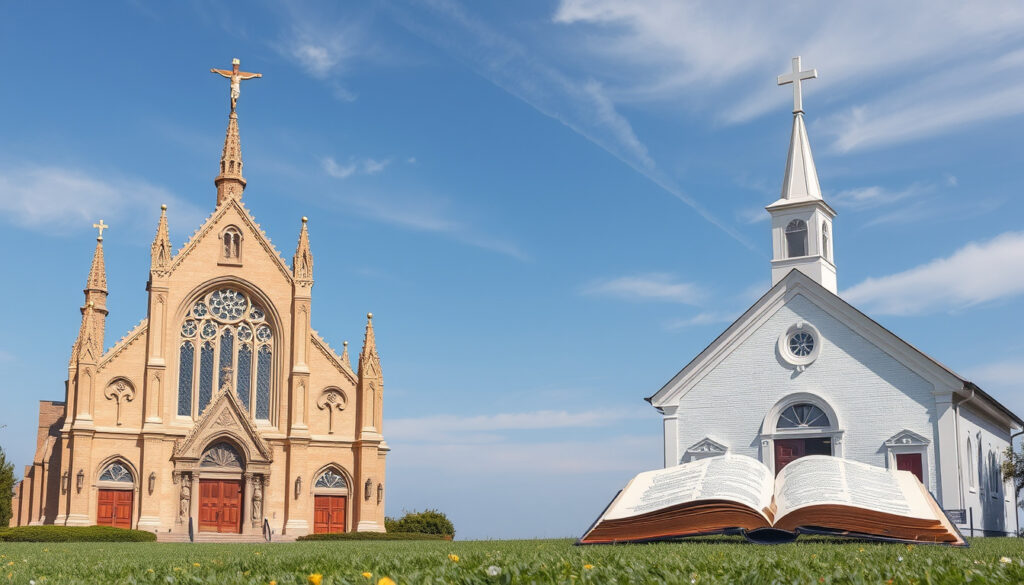
Catholic vs Christian: Key Differences Explained
Few topics spark as much curiosity as the difference between Catholic and Christian. The short answer: all Catholics are Christians, but not all Christians are Catholic. This guide breaks down the split that occurred during the Reformation and explains the key differences in authority, sacraments, and salvation.
Catholics worldwide: 1.3 billion · Protestants worldwide: ~900 million · Great Schism: 1054 · Reformation: 1517 · Protestant denominations: 30,000+
Snapshot of Core Differences
Protestant Bible alone (sola scriptura)
Protestant 2 sacraments (typically)
Protestant Faith alone (sola fide)
Protestant Bible alone (sola scriptura)
What is the difference between Catholic and Christianity?
The short answer: Catholicism is one branch of Christianity. Christianity is the broader religion, and Catholics are the largest group within it. Here are the specific differences that set them apart.
The most important difference is authority. Catholics recognize the Pope as the successor of St. Peter and the visible head of the Church. Protestants—whether Lutheran, Baptist, or nondenominational—reject papal authority and hold that the Bible alone is the ultimate guide for faith and practice.
The table below outlines the main contrasts between Catholic and Protestant Christianity.
| Dimension | Catholicism | Protestantism |
|---|---|---|
| Head of church | The Pope (Bishop of Rome) | No single leader; varies by denomination |
| Sacraments | 7 sacraments (Baptism, Eucharist, Confirmation, Penance, Anointing of the Sick, Holy Orders, Matrimony) | Generally 2: Baptism and Communion (varies) |
| Source of authority | Bible + Tradition + Magisterium | Bible alone (sola scriptura) |
| Salvation | Faith expressed through works ( sanctifying grace ) | Faith alone (sola fide) |
| Eucharist | Real Presence (transubstantiation) | Symbolic memorial or spiritual presence |
| View of Mary | Venerated; intercessor; sinless | Honored but not prayed to; not mediator |
| Purgatory | Believed; purification after death | Generally rejected |
Do Catholics and Christians believe in the same God?
Yes. Both affirm the Nicene Creed: one God in three Persons — Father, Son, and Holy Spirit. Catholics and mainstream Protestants share this core belief. Differences arise not in who God is, but how God relates to believers—through Church authority or directly through scripture.
Are Catholics considered Christians?
Yes. Catholicism is the largest branch of Christianity. The Catholic Church teaches that all baptized Christians are, to varying degrees, part of the Body of Christ. The term “Christian” includes Catholics, Orthodox, Protestants, and other groups that confess Jesus as Lord (Pew Research Center).
How did Christianity split?
The first major split was in 1054, when the Roman Catholic and Eastern Orthodox churches separated over the authority of the Pope and the wording of the Nicene Creed. The second major split occurred during the Protestant Reformation (1517 onward), when figures like Martin Luther, John Calvin, and others broke with Rome over issues of authority, salvation, and sacraments.
What do Catholics and Protestants disagree on?
The core disagreements fall into five categories:
- Authority: Catholics see the Pope as Christ’s representative on earth and hold that the Magisterium (the Pope and bishops) interprets Scripture. Protestants hold that each believer interprets the Bible under the guidance of the Holy Spirit.
- Sacraments: Catholics have seven sacraments (Baptism, Confirmation, Eucharist, Penance, Anointing of the Sick, Holy Orders, Matrimony). Most Protestants recognize only Baptism and Communion as sacraments.
- Salvation: Catholics teach that faith is expressed through good works; Protestants teach that salvation comes through faith alone (sola fide), with good works being evidence of faith, not its cause.
- Mary and the Saints: Catholics venerate Mary and the saints, asking for their intercession. Protestants generally honor Mary as the mother of Jesus but do not pray to her or to saints.
- Purgatory: Catholics believe in a state of purification after death; most Protestants reject the concept as unbiblical.
Do Catholics and Christians believe in the same God?
Yes. Both Catholics and Protestants affirm the Nicene Creed, confessing one God in three Persons—Father, Son, and Holy Spirit. The core confession of Jesus Christ as Lord and Savior is identical. The difference is not which God is worshipped, but how authority and tradition shape that worship (Catechism of the Catholic Church).
Is Catholicism a type of Christianity?
Yes. Catholicism is the largest single denomination within Christianity, representing about 50% of all Christians worldwide. The Catholic Church teaches that it is the “universal church” founded by Christ, while Protestant denominations trace their origins to the 16th-century Reformation.
What are the 5 requirements of a Catholic?
The Catholic Church calls these the “Precepts of the Church” — the minimum obligations for practicing Catholics:
- Attend Mass on Sundays and holy days of obligation.
- Confess sins at least once a year (or more often if in mortal sin).
- Receive Holy Communion at least during the Easter season.
- Observe the days of fasting and abstinence (Ash Wednesday, Good Friday, and Fridays in Lent).
- Provide for the needs of the Church (time, talent, treasure).
What is not allowed for Catholics?
Catholic moral teaching categorizes sins as venial (less serious) or mortal (grave matter committed with full knowledge and consent). Mortal sins break one’s relationship with God and require sacramental confession. Examples include:
- Abortion, euthanasia, and contraception
- Blasphemy and taking the Lord’s name in vain
- Adultery, fornication, and homosexual acts
- Murder, theft, and bearing false witness
- Missing Mass on a Sunday or holy day of obligation without a serious reason
These teachings come from the Catechism of the Catholic Church.
What is the difference between Christianity and Roman Catholicism?
“Christianity” is a broad term for all who follow Jesus Christ. “Roman Catholicism” is a specific tradition within Christianity. All Roman Catholics are Christian, but not all Christians are Roman Catholic.
The differences come down to authority: Catholics hold that the Pope (successor to Peter) has divine authority; most Protestant groups hold that Scripture alone is the Church’s ultimate authority.
Do Catholics and Christians read the same Bible?
Almost. The Catholic canon includes 73 books (46 Old Testament + 27 New Testament). Protestant Bibles have 66 books—they removed the deuterocanonical books (Tobit, Judith, Wisdom, Sirach, Baruch, 1-2 Maccabees, and parts of Daniel and Esther) during the Reformation. So, while the New Testament is identical, the Catholic Bible is larger.
What are the 5 requirements for Catholics?
The Precepts of the Church outline the minimal obligations of a Catholic:
- Attend Mass on Sundays and holy days of obligation.
- Confess sins at least once a year.
- Receive the Eucharist at least once during the Easter season.
- Observe the prescribed days of fasting and abstinence.
- Provide for the material needs of the Church according to one’s ability.
What is the difference between Catholic and Protestant baptism?
Catholic baptism typically involves pouring or sprinkling water over the infant’s head (or immersion of an adult) while saying the Trinitarian formula. Most Protestant denominations practice believer’s baptism (full immersion) for those who can personally profess faith, though some (e.g., Lutherans, Anglicans) also baptize infants. Catholics view baptism as necessary for salvation (John 3:5). Protestants generally see it as symbolic.
Key Differences at a Glance
“The Catholic Church teaches that the sacraments are efficacious signs of grace, instituted by Christ and entrusted to the Church, by which divine life is dispensed.”
Catechism of the Catholic Church (source)
“For the Protestant Reformation, the key principle was sola scriptura — the Bible alone is the ultimate authority in matters of faith and practice.”
Britannica summary of Reformation principles
Why did the Reformation happen?
The Reformation was a 16th-century movement that protested abuses in the medieval Church and sought doctrinal reform. Key issues included the sale of indulgences, the authority of the Pope, and the role of Scripture vs. Tradition. The Reformation resulted in the Lutheran, Reformed, and Anglican traditions, and later the Baptist and Methodist movements.
Catholics 1.3B · Protestants 900M (including Anglicans)
Is saying “heck” a sin?
The Catholic moral tradition distinguishes between intentional blasphemy (gravely sinful) and casual expressions that may not be sinful. “Heck” is considered a mild euphemism and is not intrinsically sinful, though context matters. The Catechism warns against “dirty words” (CCC 2153) but does not list specific words.
Snapshot: Catholic vs. Protestant Comparison
Core Beliefs
- Authority: Catholic → Pope & Magisterium; Protestant → Bible alone
- Salvation: Catholic → faith + good works; Protestant → faith alone
- Eucharist: Catholic → Real Presence (transubstantiation); Protestant → symbolic memorial in most denominations
Church Structure
- Global leader: The Pope (1.3 billion members)
- Protestant: No single leader; denominations have varying polities (episcopal, presbyterian, congregational)
Sacraments
- Catholic: 7 sacraments (Baptism, Confirmation, Eucharist, Penance, Anointing, Holy Orders, Matrimony)
- Protestant: 2 sacraments (Baptism, Communion) in most traditions
Key Figures
- Catholic: Pope Francis, bishops in communion with Rome
- Protestant: Martin Luther, John Calvin, and countless denominational leaders
What are the 5 requirements for Catholics?
The Catholic Church’s precepts (minimum requirements) are: attend Mass on Sundays and holy days, confess sins at least once a year, receive the Eucharist during Easter, observe fasting and abstinence rules, and support the Church financially. These are outlined in the Catechism of the Catholic Church.
What is not allowed for Catholics?
Beyond the Ten Commandments, Catholic moral theology specifies acts considered intrinsically evil (mala in se). These include direct abortion, euthanasia, contraception, blasphemy, and sacrilege. The Church also forbids missing Sunday Mass without good cause. As the Catechism states: “Every sign of unjust discrimination against them (non-Catholics) must be avoided.”
Timeline: Catholic vs Protestant
- 1054: Great Schism splits Roman Catholic and Eastern Orthodox.
- 1517: Martin Luther posts 95 Theses, sparking the Reformation.
- 1520s: Luther excommunicated; Calvin’s Institutes published.
- 1545–1563: Council of Trent — Catholic Church defines doctrines in response to Reformation.
- 1962–1965: Second Vatican Council — Catholic Church opens to ecumenical dialogue.
ascensionpress.com, en.wikipedia.org, firstwttn.org, stboc.org, britannica.com, facebook.com, britannica.com, catholicculture.org, archstl.org, essays.wisluthsem.org
While all Catholics are Christians, the two terms are not interchangeable, and a detailed breakdown of Catholic vs Christian differences highlights key distinctions in authority and sacraments.
Frequently Asked Questions
Is a Catholic a Christian?
Yes. Catholicism is the largest branch of Christianity. Christians include Catholics, Protestants, and Orthodox. All affirm Jesus as Lord and Savior.
Do Catholics and Christians worship the same God?
Yes. Both confess one God in three Persons: Father, Son, and Holy Spirit. Differences lie in how God communicates authority (Scripture + Tradition vs. Scripture alone).
Why do Catholics pray to Mary?
Catholics do not worship Mary. They ask Mary and the saints to intercede for them, much like asking a friend to pray for you. This practice is based on the communion of saints (CCC 957).
Do Protestants pray to Mary?
Most Protestant traditions do not pray to Mary or ask for her intercession, citing 1 Timothy 2:5 — “There is one mediator between God and men, the man Christ Jesus.”
Can a Catholic marry a non-Catholic?
Yes, with permission from the local bishop. The Catholic party must promise to raise any children in the Catholic faith. Such marriages are called “mixed marriages.”
What do Catholics believe about salvation?
Catholics believe that salvation is a gift from God through faith in Jesus Christ, but that good works (done in a state of grace) are necessary evidence of that faith. Protestants hold to salvation by faith alone (sola fide).
Practical Differences in Worship
Catholic liturgy centers on the Eucharist as a sacrifice and a sacrament. Protestant worship varies widely—from highly liturgical (Lutheran, Anglican) to free-form (evangelical, non-denominational). Catholics venerate saints and Mary; Protestants focus on Christ alone.
The bottom line: Catholicism and Protestant Christianity share an overwhelming amount of common ground—the same God, the same Jesus, and the same Bible. The differences, while important, are rooted in the Reformation-era debates about authority, grace, and the sacraments.
“All Christians are Catholic? No. All Christians are part of the universal Church in some sense, but full communion requires acceptance of the entire deposit of faith.”
— Catechism of the Catholic Church §838
How many Christians are Catholic?
According to the Pew Research Center, there are approximately 1.3 billion Catholics worldwide, out of about 2.5 billion Christians. That means roughly 50% of all Christians are Catholic.
Key Differences in Practice
- Sunday worship: Catholics attend Mass; Protestants have services with preaching and singing.
- Eucharist: Catholics believe in transubstantiation (bread and wine become body and blood of Christ). Most Protestants see Communion as symbolic.
- Confession: Catholics practice sacramental confession to a priest; most Protestants confess directly to God.
- Use of images: Catholics use crucifixes, statues, and icons. Protestants generally avoid religious images in worship.
Does the Bible forbid praying to Mary?
The Bible nowhere explicitly forbids asking for the intercession of the saints. Catholics cite Revelation 5:8 and Revelation 8:3-4 as examples of saints presenting prayers to God. Protestants often point to 1 Timothy 2:5 — “For there is one God and one mediator between God and men, the man Christ Jesus” — as grounds against invoking saints.
Is saying “heck” a sin?
The Catholic Church does not have a specific teaching on the word “heck” itself. However, using any language in a way that disrespects God or others can be sinful. “Heck” is generally considered a mild substitute for “hell” and is not typically considered grave matter. The Catechism advises avoiding words that offend charity (CCC 2153).
What are the 5 requirements for Catholics?
- Sunday Mass — Attend Mass every Sunday and on holy days of obligation.
- Confession — Confess sins at least once a year if in mortal sin.
- Easter Duty — Receive the Eucharist at least during the Easter season.
- Fasting and Abstinence — Observe the prescribed fast and abstinence on Ash Wednesday and Good Friday, and abstain from meat on Fridays of Lent.
- Support the Church — Contribute to the material needs of the Church, each according to ability.
- 33–100 AD: Apostolic Church founded by Jesus’s apostles.
- 1054: Great Schism — Roman Catholic and Eastern Orthodox divide.
- 1517: Martin Luther posts 95 Theses; beginning of Protestant Reformation.
- 1534: Act of Supremacy — King Henry VIII breaks from Rome, establishes Church of England.
- 1560: Scottish Reformation; Presbyterianism established.
- 1962–1965: Second Vatican Council — Catholic Church opens to ecumenical dialogue.
- Authority: Catholics follow the Pope and Magisterium; Protestants follow Scripture alone.
- Sacraments: Catholics have seven; most Protestants have two.
- Salvation: Catholic: faith + works; Protestant: faith alone.
- Tradition: Catholic teaching includes Sacred Tradition; Protestants emphasize sola scriptura.
- Mary and the Saints: Catholics venerate Mary; Protestants honor her but see intercession as unbiblical.
- Catechism of the Catholic Church — official Catholic teaching
- Pew Research: Global Christianity — demographic data
- Britannica: Reformation key facts
- Bible Gateway — compare Catholic and Protestant Bible translations
It’s also important to note that Catholics believe in the Real Presence of Christ in the Eucharist — a belief not shared by most Protestant denominations. The table below summarizes the main contrasts.
| Topic | Catholic | Typical Protestant |
|---|---|---|
| Source of authority | Bible + Tradition + Magisterium | Bible alone (sola scriptura) |
| Pope | Supreme head of Church on earth | No central authority |
| Sacraments | 7 | 2 (or symbolic) |
| Salvation | Faith + good works | Faith alone (sola fide) |
| Eucharist | Real Presence (transubstantiation) | Memorial (symbolic in many traditions) |
| Mary | Mother of God, venerated, immaculately conceived | Honored, but fully human |
Historical Timeline of the Split
“The Catholic Church teaches that the Eucharist is the body, blood, soul, and divinity of Christ. This is what we call the Real Presence.”
How do Baptists differ from Catholics?
Baptists are a Protestant denomination. Key differences include: baptism of believers only (not infants), local church autonomy, rejection of papal authority, and a literal interpretation of Scripture. Baptists also typically reject the Catholic teaching on the Real Presence and the seven sacraments.
What is the difference between Christianity and Catholicism?
“Christianity” is the umbrella term for all groups that follow Jesus Christ. “Catholicism” is the largest branch within Christianity. The key difference: Catholics recognize the pope as the visible head of the Church; most Protestant groups do not. Catholics also hold to seven sacraments, the Real Presence in the Eucharist, and the intercession of saints and Mary.
Key Differences Between Catholics and Christians
The most significant divides are:
Why the Differences Matter Today
The Catholic-Protestant divide shaped Western history for centuries. While ecumenical dialogue has narrowed gaps, the theological differences remain significant. For Catholics, the Church is the Body of Christ with visible authority. For Protestants, the Church is the community of believers gathered around Scripture.
Frequently Asked Questions
Is Catholicism a type of Christianity?
Yes. Catholicism is the oldest and largest branch of Christianity, with over 1.3 billion members.
Do Catholics and Protestants read the same Bible?
Almost. The Catholic Bible includes seven additional Old Testament books (the deuterocanonical books). The Protestant Old Testament has 39 books; the Catholic has 46. The New Testament is the same.
Do Catholics believe in predestination?
Generally, no. Catholics affirm that God desires all to be saved and that human free will cooperates with grace. The Council of Trent condemned the Calvinist doctrine of double predestination.
Can Catholics have tattoos?
Yes. The Catechism does not forbid tattoos unless they are blasphemous or immodest. Leviticus 19:28 is understood as a ceremonial law that does not bind Christians.
Further Reading
More related posts
 T-Bill Interest Rate Today: Current Rates and How to Invest
 Niat Puasa Ramadhan Sebulan: Bacaan, Hukum, dan Tata Cara
 Arsenal F.C. vs Crystal Palace F.C. Head-to-Head, History & More
 Singapore Bank Fixed Depo it Rate Drop: Be t FD Rate May 2026
 Malaysia ASEAN Summit Trump: Peace Deal and US Ties
 Leeds United F.C.: Finances, Debt, and Irish Fan Base
 Papa Jones BBQ and Grill: Menu, Halal, Reviews
 How Great Is Our God Lyrics, Chords, and Background