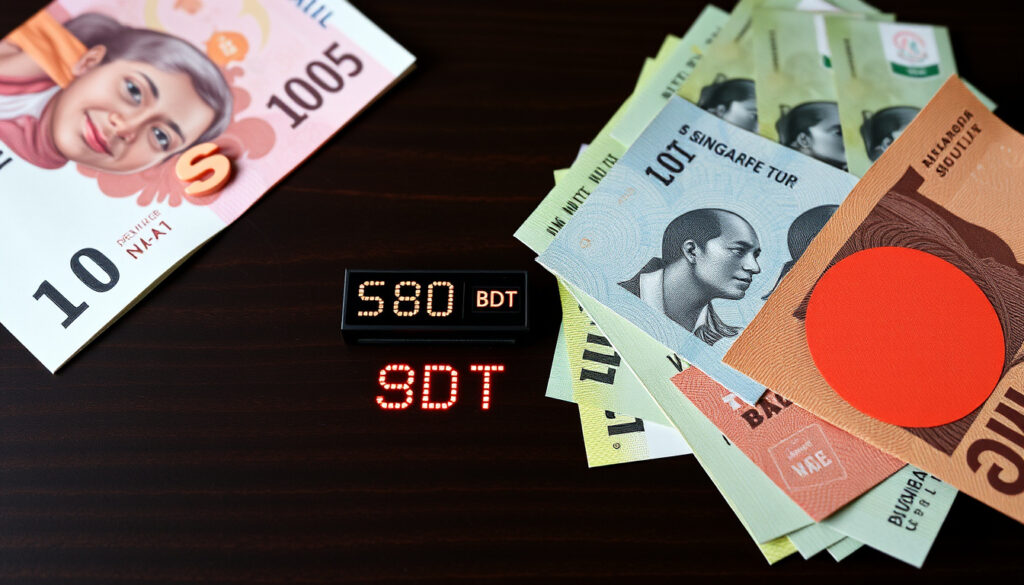
Singapore Dollar to Bangladeshi Taka Rate: SGD to BDT Today
If you are sending money from Singapore to Bangladesh, the exchange rate you see on a screen is rarely the rate your family receives. Fees, payment methods, and provider spreads all chip away at the headline number.
Mid-market rate (XE.com): 96.45 BDT ·
Wise rate: 96.12 BDT ·
Ria rate: 96.27 BDT
Quick snapshot
- Mid-market rate: 1 SGD = 96.4512 BDT (XE.com)
- Wise quoted 96.12 BDT for 1 SGD and says it converts at the mid-market rate (Wise (money transfer platform))
- Dash example for 1,000 SGD to bKash: 96,354.06 BDT after a 2 SGD fee (Dash (Singapore remittance app))
- Daily rates at Agrani, Prime, and Islami Bank are not published in one verifiable place (Western Union (global remittance service))
- Western Union’s exact SGD-to-BDT rate depends on payment and payout option (Western Union (global remittance service))
- Remitly’s 93.90 BDT quote can shift with amount, funding method, and delivery speed (Remitly (remittance app))
- DBS same-day BDT transfer cutoff: 11:00 a.m. Singapore time (DBS Singapore (bank guidance))
- Rates move with market conditions through the day, so a morning quote is not an afternoon guarantee (DBS Singapore (bank guidance))
- Rate quotes update through the day; the confirmation screen is where the price is locked
- Compare the delivered BDT amount, not the headline rate, before you confirm
Seven numbers, one pattern: the advertised rate is a starting point, and the delivered amount is the real price.
| Item | Value | Source |
|---|---|---|
| Base currency | Singapore Dollar (SGD) | — |
| Quote currency | Bangladeshi Taka (BDT) | — |
| Mid-market rate | 1 SGD = 96.4512 BDT | XE.com |
| Last updated | 13 Oct 2026 | XE.com snapshot |
| Ria quote | 1 SGD = 96.27 BDT | Ria (international transfer service) |
| Remitly example quote | 1 SGD = 93.90 BDT | Remitly (remittance app) |
| DBS transfer rules | Same-day cutoff 11:00 a.m.; daily limit 200,000 SGD | DBS Singapore |
How much is $1 dollar in Singapore in Bangladeshi Taka today?
One Singapore dollar is worth 96.4512 BDT at the mid-market rate, but that figure is the benchmark, not a price you can actually buy. Every service that moves money from Singapore to Bangladesh adds something on top — a fee, a rate spread, or both.
Mid-market conversion from XE
Published: 13 Oct 2026
The XE.com converter is the standard reference for the mid-market rate, and it is the number most people check first. It is also the number least likely to match the recipient’s bank balance.
Wise and Ria rates
- Wise displayed 96.12 BDT for 1 SGD and says its conversion uses the mid-market rate (see snapshot above).
- Ria quoted 96.27 BDT for 1 SGD (Ria (international transfer service)).
- Remitly showed 93.90 BDT — about 2.5 taka below the mid-market rate — with rates and fees varying by amount, payment method, and delivery option (Remitly).
The spread between 93.90 and 96.4512 BDT is 2.55 taka per dollar. On a 1,000 SGD remittance, that is around 2,550 BDT that the recipient never sees — before any fee is even deducted.
Impact of fees on the final amount
Wise’s example fee for a Singapore-to-Bangladesh transfer ranges from 14.22 SGD (funding from a Wise balance) to 15.07 SGD (bank transfer) to 115.36 SGD (debit card) — a 101 SGD swing caused entirely by how the transfer is funded (Wise).
Western Union adds its own layer: exchange rates and fees vary by payment and payout option and may change before you confirm (Western Union). For 1 SGD, that variation is a rounding error; for a monthly salary transfer, it is the difference between a market-beating deal and a quietly expensive one.
The takeaway for the first question: the headline rate tells you less than the fee schedule does. A quote near the mid-market rate with a 15 SGD fee can cost more than a slightly worse rate with no fee.
How much is 2 Singapore dollars worth in Bangladeshi taka today?
Two Singapore dollars is the smallest real test: the math is simple, the rates are the same ones from the 1 SGD section, and the gap is already visible in taka.
Simple multiplication of the mid-market rate
- Mid-market: 2 SGD = 192.90 BDT (96.4512 × 2)
- Wise: 2 SGD = 192.24 BDT at its quoted rate
- Ria: 2 SGD = 192.54 BDT at its quoted rate
These are rate-based calculations, not delivered amounts — any transfer fee would reduce the taka that actually arrives.
Comparing rates from different providers for 2 SGD
Lowest provider quote: 192.24 BDT (Wise) ·
Spread: 0.66 BDT
The gap between the highest quote in this comparison and the lowest provider quote is 0.66 BDT. That is tiny on its own, and it scales linearly with the amount you send.
Example: 2 SGD = 192.90 BDT (mid-market)
A 0.66 BDT gap on 2 SGD becomes roughly 330 BDT on 1,000 SGD. The rate comparison that looks pedantic at small amounts becomes real money at salary-remittance scale.
The math is the same for every multiple: divide by 100 for cents, multiply by 10 or 100 for larger amounts. What changes is whether the provider’s fee swallows the gain.
The pattern: small transfers are a fair comparison test, because the rate differences scale perfectly while the fee structure does not.
How much is $100 dollars in BDT?
At 100 SGD the spread starts to look like money. The mid-market value is 9,645.12 BDT; the weakest provider quote in this comparison is 9,390 BDT — a gap of roughly 255 BDT before fees.
Conversion for 100 SGD at mid-market
- Mid-market: 100 SGD = 9,645.12 BDT (96.4512 × 100)
- Wise: 100 SGD = 9,612 BDT at its quoted rate
- Ria: 100 SGD = 9,627 BDT at its quoted rate (Ria)
- Remitly: 100 SGD = 9,390 BDT at its displayed example rate (Remitly)
Bank rates vs online services for larger transfers
- Agrani Bank, Prime Bank, and Islami Bank publish daily SGD rates that typically include a spread above the mid-market level.
- An exchange through those banks may require a branch visit, and the exact rate is hard to verify online in advance.
Online services publish their numbers instantly, which makes them easier to compare — and the fee is displayed before you confirm. That transparency is the main advantage of an app over a branch counter.
- Dash’s published examples for 1,000 SGD: 96,354.06 BDT to a bKash wallet (2 SGD fee), 96,318.24 BDT to a bank account (3 SGD fee), and 95,736.87 BDT for cash pickup (3.50 SGD fee) (Dash).
Why rates differ for large amounts
Bank account: 96,318.24 BDT ·
Cash pickup: 95,736.87 BDT
The bKash route delivers about 617 BDT more than cash pickup on the same 1,000 SGD — not because the fee is lower, but because Dash applies a different rate to each payout method. The fee gap explains only about 145 BDT of the difference; the rest is exchange-rate policy.
The implication for anyone sending 100 SGD or more: the payout method is a pricing decision. Choosing bKash over cash pickup is worth more than shopping for a marginally better headline rate.
What is the price of 1 Singapore Cent in Bangladeshi Taka?
The cent is where exchange rates stop being abstract. One Singapore cent is one-hundredth of a dollar, and its taka value is simply the mid-market rate divided by 100 — about 0.96 BDT.
Conversion of 1 cent = 0.01 SGD
Mid-market value: 0.9645 BDT ·
Rounded: 0.96 BDT
The calculation uses the same XE.com mid-market rate of 96.4512 BDT cited in the key facts table above. At this size, transfer fees would exceed the value of the amount itself, so the cent is best used as a unit of math rather than a real transaction.
Actual value in BDT
Wise: 0.9612 BDT ·
Ria: 0.9627 BDT
All three values round to the same single taka, which is why cents matter only when they are multiplied across a larger transfer. The difference of 0.0033 BDT per cent is invisible on a coin and measurable on a remittance.
Why cents matter for small transactions
Cents are the purest lens for the rate spread: the same markups that cost a fraction of a taka on one cent cost hundreds of taka on a real transfer.
The cent conversions do not change a transfer decision by themselves. They exist to make one point: the rate spread is proportional, and the longer you look at it, the cheaper the best provider looks.
The takeaway: the cent reveals the market’s pricing behavior in miniature — pick a provider that treats one cent fairly, and the same fairness scales to 1,000 SGD.
How much is 20 Singapore cents in Bangladeshi taka?
Twenty Singapore cents is 0.20 SGD, and because the taka is worth so much less than the dollar, the conversion produces a surprisingly readable number: about 19 taka.
20 cents = 0.20 SGD
Mid-market value: 19.29 BDT ·
Wise: 19.22 BDT ·
Ria: 19.25 BDT
Conversion using the mid-market rate
- The math is 0.20 × 96.4512 = 19.29024 BDT, which rounds to 19.29.
- At Wise’s rate it is 19.22 BDT; at Ria’s it is 19.25 BDT.
- The spread across the three quotes is 0.07 BDT at this size — less than one percent of the value.
Real-world example
20 cents is small enough to ignore and large enough to demonstrate the spread. The 0.07 BDT gap on 20 cents becomes 350 BDT on 1,000 SGD — the quiet cost of choosing the wrong provider.
Small-change conversions are a stress test for the whole market. The provider that charges the least at 20 cents scale usually wins at 1,000 SGD scale — before fees.
What this means: the cent-to-taka math is not about pocket change. It is about which provider respects the spread, and that discipline compounds with every zero you add.
SGD to BDT: providers compared
Seven routes, one pattern: the lowest headline rate is not the lowest cost once fees and payout method are counted.
| Provider | Rate for 1 SGD | Fee example on 1,000 SGD | Where the cost hides |
|---|---|---|---|
| XE.com (reference rate) | 96.4512 BDT | Not a transfer service | Mid-market baseline; consumers cannot transact at this price |
| Wise (money transfer platform) | 96.12 BDT | 15.07 SGD by bank transfer | No spread on the rate; explicit fee is deducted first |
| Ria (international transfer service) | 96.27 BDT | Varies by payout | Rate plus delivery fee |
| Western Union (global remittance service) | Varies | Zero-fee first transfer with PayNow or bank transfer | Customer rate can include a markup over mid-market |
| Remitly (remittance app) | 93.90 BDT | Varies by amount and payment method | Lower headline rate; fees depend on speed and funding |
| Dash (Singapore remittance app) | Market-adjusted | 2–3.50 SGD | Delivered amount depends on payout: bKash, bank account, or cash pickup |
| DBS Singapore (bank transfer) | Bank-set | Varies | Same-day if submitted before 11:00 a.m.; 200,000 SGD daily limit |
What this means: the decision is not which rate is highest but which delivered amount is highest after fees. Dash’s bKash example delivers 96,354.06 BDT; a bank-funded transfer at Wise’s numbers delivers roughly 94,671 BDT — a difference of about 1,700 BDT on the same 1,000 SGD.
Upsides and downsides of each route
Each provider optimizes for a different user: the rate-focused saver, the speed-focused sender, or the recipient who needs cash, not numbers.
Upsides
- Wise converts at the mid-market rate and shows fees before confirmation
- Dash’s bKash route delivers 96,354.06 BDT on 1,000 SGD with only a 2 SGD fee
- Bangladesh’s 2.5% remittance incentive can add about 2,400 BDT on that amount if eligible
- Western Union offers a zero-fee first transfer when paying with PayNow or bank transfer
- DBS supports same-day processing if the transfer is submitted before 11:00 a.m.
Downsides
- Debit-card funding can push a Wise fee to 115.36 SGD — about eight times the 14.22 SGD cost of funding from a Wise balance
- Remitly’s 93.90 BDT quote sits about 2.5 taka below the mid-market rate
- Cash pickup via Dash delivers 95,736.87 BDT — about 617 BDT less than bKash on 1,000 SGD
- Agrani, Prime, and Islami Bank rates are hard to verify online and may require a branch visit
- Western Union’s customer rate can include a markup, and the final rate varies by payout option
The trade-off: cheap funding methods reward the sender who plans; expensive ones tax the sender who is in a hurry. The rate table barely changes, but the delivered amount can swing by thousands of taka.
How to get the best SGD-to-BDT rate in six steps
These steps use only what the providers themselves publish — no rate-chasing, no timing tricks, just the discipline of comparing the final number.
Step 1: Record the mid-market rate
- Open XE.com’s SGD-to-BDT converter and note the mid-market rate (96.4512 BDT in this snapshot).
- Use it as your reference, not your expectation.
The mid-market rate is the ceiling of a fair deal. Any provider that quotes within a few hundredths of it is pricing honestly; anything more than a taka below it is charging you a spread.
Step 2: Compare delivered amounts, not headlines
- Open Wise, Ria, Remitly, Dash, and Western Union side by side.
- Enter the same 1,000 SGD and write down the BDT that arrives, not the rate that is advertised.
Dash’s own examples show a 617 BDT difference between bKash delivery and cash pickup on the same amount. The headline rate would never reveal that.
Step 3: Choose the cheapest funding method
- Prefer a Wise balance or bank transfer over debit or credit cards.
- Wise’s example fee is 14.22 SGD from a Wise balance, 15.07 SGD by bank transfer, and 115.36 SGD by debit card.
Funding method, not the exchange rate, is the single biggest cost lever on most transfers.
Step 4: Pick the payout method that matters to the recipient
- Bank account or bKash wallet beats cash pickup on delivered value.
- Cash pickup is the fallback for recipients without a bank account or wallet.
The trade-off is convenience versus value: a cash pickup costs about 0.6% of the transfer amount in lost taka (617 BDT on 1,000 SGD), just because of the payout channel.
Step 5: Look for the incentives before you send
- Check whether the recipient qualifies for Bangladesh’s 2.5% cash incentive on expatriate remittances.
- Confirm the incentive with the receiving bank or wallet provider before assuming it applies.
The incentive can add roughly 2,400 BDT on a 1,000 SGD transfer — more than the fee difference between most providers.
Step 6: Confirm everything before the cutoff
- Submit before 11:00 a.m. Singapore time for same-day processing through DBS.
- Check the final fee and rate on the confirmation screen — Western Union displays them before you send.
The last screen is where the real deal is struck; the rate you saw an hour ago is not the rate you get locked in at.
The pattern: the six-step approach moves from rate-checking to action, eliminating guesswork.
What’s confirmed, what’s still unclear
Some numbers in this guide were verified against provider pages on the same day; others move too often to pin down with certainty. That distinction matters more than the rate itself.
Confirmed facts
- 1 SGD = 96.4512 BDT at the mid-market rate, per XE.com.
- Wise quoted 96.12 BDT and states it converts at the mid-market rate (see snapshot above).
- Dash’s published example for 1,000 SGD to bKash: 96,354.06 BDT after a 2 SGD fee.
- DBS lists an 11:00 a.m. cutoff and a 200,000 SGD daily limit for Bangladesh transfers.
What’s unclear
- The day-to-day SGD rates actually applied by Agrani Bank, Prime Bank, and Islami Bank.
- Western Union’s exact rate for a specific transfer at the moment you send.
- Whether Remitly’s 93.90 BDT quote, or any quote, survives to the confirmation screen.
- Whether a given recipient qualifies for the 2.5% remittance incentive and when it is credited.
- Whether a transfer submitted near the 11:00 a.m. cutoff settles the same day in practice.
Why this matters: the difference between the confirmed and the unclear is exactly where transfer fees hide. If a provider will not show a number before the confirmation screen, assume the worst case.
What the providers say
Three providers, three disclosures — together they explain most of the price difference.
“Rates and fees are variable and depend on amount, payment method, and delivery option.”
Remitly (remittance platform)
“Bangladesh expatriate remittances may receive a 2.5% government cash incentive.”
Dash (Singapore-based remittance app)
“Bangladesh account transfer and cash pickup in BDT: same-day processing for requests received by 11:00 a.m. Singapore time.”
DBS Singapore (bank guidance)
The common thread: each provider points to the confirmation screen as the moment the real price is set. The rate on a homepage is marketing; the rate on the final screen is the contract.
Final takeaway
The gap between the headline rate and the delivered amount is the real story. On a 1,000 SGD transfer, Wise’s own cost example for bank funding leaves roughly 94,671 BDT after its 15.07 SGD fee; Dash’s published bKash example delivers 96,354.06 BDT — a difference of about 1,700 BDT before the 2.5% remittance incentive is even added. For anyone in Singapore sending money to Bangladesh, the choice is clear: compare the delivered BDT amount, not the advertised rate, or your recipient absorbs the cost of the spread.
Frequently asked questions
Is it better to exchange SGD in Singapore or Bangladesh?
For most senders, yes — convert in Singapore through a digital service. Wise, Ria, Remitly, Dash, and Western Union show their rates and fees before you confirm, and the rate is locked at that point. Exchanging in Bangladesh at a branch bank usually means accepting the bank’s spread, and the exact rate is hard to verify in advance.
How do I send money from Singapore to Bangladesh?
Open the provider’s app or website, select Bangladesh, enter the SGD or BDT amount, choose a payout method (bank account, bKash wallet, or cash pickup), and review the fee and rate on the confirmation screen. Dash, for example, charges 2 SGD for bKash delivery and 3.50 SGD for cash pickup on a 1,000 SGD transfer.
What is the best time to convert SGD to BDT?
No provider in this comparison guarantees a time of day with a better rate. The reliable approach: track the mid-market rate for a few days, then send when a provider’s quoted rate sits close to it. Bangladesh’s 2.5% remittance incentive is a fixed boost, so delivery method usually matters more than the hour you send.
Are there any hidden fees when converting SGD to BDT?
Fees are disclosed, but they hide in three places: the explicit transfer fee, the spread built into the exchange rate, and the surcharge on debit-card funding. Western Union says rates and fees vary by payment and payout option; Wise shows the full cost before you confirm.
Can I use a credit card to convert SGD to BDT?
Yes, but it is the most expensive funding method in every example in this guide. Wise’s debit-card funding fee was 115.36 SGD versus 14.22 SGD from a Wise balance — about eight times the cost, before the exchange rate is applied.
What is the limit for money transfer to Bangladesh?
DBS lists a 200,000 SGD daily limit for Bangladesh account transfers and cash pickup. Limits at other providers depend on your account verification level and the payout method, so confirm the maximum before sending a large amount.
How to check the real-time SGD to BDT rate?
Check the mid-market rate on XE.com’s converter, then open the provider’s app for its live quote. Dash states that its SGD-to-BDT rate is adjusted according to market conditions and that the app should be checked for the latest rate.
Do exchange rates change on weekends?
Mid-market rates barely move when interbank markets are closed, but provider rates can still change because of demand and payout-option adjustments. The only rate that matters is the one shown on the confirmation screen when you send.
More related posts
 English to Malay Translation: Best Free Tools Guide
 What to Eat in Singapore: Must-Try Dishes & Hawker Spots
 Sentenced to Be a Hero: Season 2, Episodes, Where to Watch & More
 Synthesis 食拿酒稳: TCM Speakeasy & Northern Chinese in Suntec
 Ready or Not Game: PS5, Xbox, Price & Worth
 Singapore Zoo Ticket Price 2025: Official Rates & Discounts