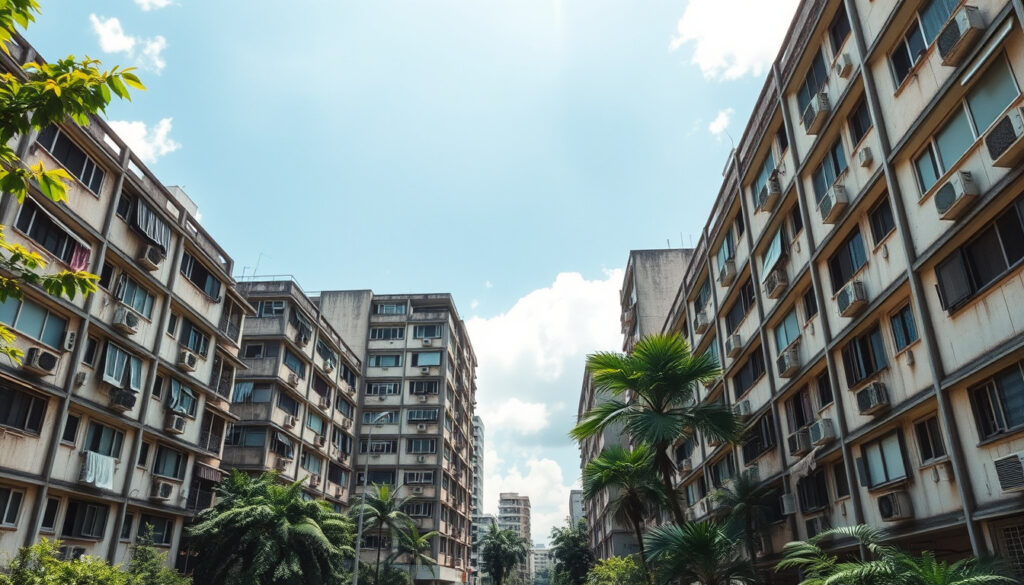
Oldest HDB in Singapore: Stirling Road 1960 Blocks & Prices
Singapore’s oldest HDB blocks stand at 45, 48 and 49 Stirling Road in Queenstown, completed in February 1960 — and they remain rental flats with no lease clock to run down. For buyers weighing whether a 60-year-old HDB flat is brave or reckless, those three unassuming 7-storey blocks hold a counterintuitive answer: the 99-year lease problem is not inevitable, just avoidable under the right tenure structure.
First HDB blocks completed: 1960 · Location: Stirling Road, Queenstown · Blocks involved: 45, 48, 49 · Lease term: 99 years · Oldest pre-HDB area: Tiong Bahru
Quick snapshot
- Blocks 45, 48 and 49 Stirling Road completed October 1960 (DOCOMOMO Singapore)
- Residents moved in during early 1961 (DOCOMOMO Singapore)
- HDB was established 1 February 1960, succeeding SIT (Remember Singapore)
- Exact 99-year lease start date for Stirling Road blocks — rental status means this is not publicly documented (DOCOMOMO Singapore)
- Whether SERS or VERS applies to Stirling Road in future planning cycles (PropertyAsiaDirect)
- 2059: First HDB blocks approach 99-year lease expiry (DOCOMOMO Singapore)
- 1960s blocks already in their final 30-year lease window (Business Times)
- 299 Queenstown blocks from the 1960s face narrowing options as lease runs down (Business Times)
- Government SERS intervention most likely path before flat reverts to State (PropertyAsiaDirect)
The key facts about Singapore’s first HDB blocks and early public housing development are summarised below.
| Fact | Value |
|---|---|
| Oldest HDB blocks | 45, 48, 49 Stirling Road |
| Completion year | 1960 |
| Estate | Queenstown |
| Standard lease | 99 years |
| HDB founding date | 1 February 1960 |
| First public sales | 1964, Queenstown |
| 1964 two-room price | $4,900 |
| 1964 three-room price | $6,200 |
Which is the oldest HDB estate in Singapore?
When people say “oldest HDB,” they usually mean one of two things: the blocks completed first by HDB, or the oldest surviving public housing area. The distinction matters. Blocks 45, 48 and 49 Stirling Road in Queenstown were the first three HDB blocks ever completed — handed over by the Singapore Improvement Trust (SIT) as unfinished shells when HDB formally launched on 1 February 1960, then finished by the new agency and officially completed in February 1960 (DOCOMOMO Singapore). Residents moved in during early 1961.
Stirling Road blocks
These three 7-storey rental blocks are still standing at Stirling Road today, and they remain rental flats — not a single unit has been sold under the Home Ownership for the People Scheme. That fact is central to understanding their story. Because they were never sold, they are not governed by the 99-year lease arrangement that applies to every HDB flat sold to the public. “Till today, the three blocks – blocks 45, 48 and 49, remain as rental flats, so the issue of a dwindling 99-year lease is immaterial,” noted DOCOMOMO Singapore (Architecture Heritage Group).
Rental status sidesteps the 99-year problem entirely — residents hold no asset they can sell, but they also face no countdown to lease expiry.
Queenstown location details
Queenstown sits in Singapore’s southwestern corridor, and its Stirling Road pocket was essentially frontier land in the late 1950s — a mix of swampland, rubber plantations, and a burial ground that the government repurposed for public housing (Remember Singapore). Today it is one of Singapore’s most centrally located mature estates, with Redhill and Dover MRT stations serving the area. The Business Times reported that 299 HDB blocks from the 1960s in Queenstown are now entering the final 30 years of their 99-year leases (Business Times).
Where is Singapore’s first HDB?
Singapore’s first HDB is most accurately described as blocks 45, 48 and 49 Stirling Road in Queenstown, completed in February 1960. Wikipedia records that “They were the first three public housing blocks completed by the Housing and Development Board (HDB) in 1960” (Wikipedia entry on Stirling Road blocks). A small footnote worth knowing: these are not the first public housing in Singapore — the SIT had already built Tiong Bahru in the 1930s — but they are the first HDB blocks.
Historical context
HDB was created on 1 February 1960 precisely to take over unfinished SIT projects and accelerate public housing delivery. By the end of 1962, HDB had completed 21,232 units. By March 1980, that figure had swollen to 334,444 units housing 67% of Singapore’s population of 2.4 million (DOCOMOMO Singapore). The pace was extraordinary by any global standard.
The first flats sold to the public — not just rented — came in 1964, at Queenstown Neighbourhood III under the Home Ownership for the People Scheme. Those 2-room units went for $4,900 and the 3-room for $6,200 (DOCOMOMO Singapore). Adjusting for inflation, that 3-room price is roughly equivalent to under $60,000 in today’s dollars — a stark contrast to modern Queenstown resale figures.
The gap between what early buyers paid and what today’s buyers face in Queenstown is not just a trivia point — it shapes who can afford to live in Singapore’s most historically significant estate, and whether the original promise of affordable homeownership still holds.
What is the oldest residential area in Singapore?
Tiong Bahru holds the title of Singapore’s oldest residential estate, predating HDB entirely. The SIT developed Tiong Bahru in the 1930s as Singapore’s first public housing estate, featuring distinctive art deco blocks that remain a landmark today. It sits roughly 3 kilometres east of Stirling Road. Unlike the Stirling Road rental blocks, Tiong Bahru’s flats have long since been sold on the 99-year lease.
Comparison to HDB estates
The key distinction is that Tiong Bahru predates HDB and even the 99-year lease structure — the SIT built its flats under different land tenure terms. HDB standardised the 99-year lease from its first sales in 1964 onward. So while Tiong Bahru is geographically older as a residential area, Stirling Road blocks are the oldest entities governed by the HDB’s modern lease framework.
Should I buy a 40-year-old HDB?
This is the question that matters most for real buyers, and the honest answer is: it depends heavily on location, remaining lease, and your financial horizon. Stirling Road and Queenstown offer a useful case study because the location premium is so strong that prices have defied lease decay in ways not seen in more peripheral estates.
Lease decay factors
Every year on a 99-year lease HDB flat, the remaining lease shrinks by one year. When a flat enters the final 30 years of its lease, bank lending becomes more constrained, CPF usage faces stricter limits, and resale options narrow. The Business Times reported in 2023 that prices for Singapore’s oldest HDB flats were flattening and demand slowing as buyers priced in the looming expiry (Business Times). For Queenstown’s 1960s flats specifically, Stacked Homes documented a 5-room resale reaching approximately $938,000 — a 22% gain from the $790,000 recorded in 2014 (Stacked Homes).
Price considerations
Current SRX listings show Stirling Road 3-room improved units (1970 build) at around $395,000 for 60 sqm ($611 psf), and larger units at $488,000 and above (SRX property listings). PropertyGuru listed one rare HDB terrace unit at 42 Stirling Road — a landed-format public housing unit — at $930,000 for 1,284 sq ft with 3 bedrooms (PropertyGuru property guide). Start Trades documented buyers paying over $900,000 for Stirling Road units in 2022 despite their age and declining lease position (Start Trades).
What this means: for a flat with 35–40 years of lease remaining, buyers are still spending close to half a million dollars. The location premium — Queenstown’s walkability, MRT access, and mature neighbourhood — is doing significant heavy lifting.
For investors banking on capital appreciation, a flat with 30 years of lease left offers almost no runway for further lease extension. The trade-off between location premium and lease risk is sharper in older estates than anywhere else in Singapore.
What will happen after 99 years of leasehold in Singapore?
This question is technically unanswered for HDB because no HDB flat has ever reached its 99-year lease end — the oldest sale flats date only to 1964, so the first expirations are roughly 38 years away. But the policy framework is already established.
Lease expiry process
Under current policy, upon 99-year lease expiry an HDB flat reverts to HDB, then to the State, with no automatic compensation paid to the owner (PropertyAsiaDirect). This is a source of anxiety for many buyers, but it has an important caveat: the government has intervened proactively via the Selective En bloc Redevelopment Scheme (SERS), which allows HDB to compulsorily acquire entire blocks before lease expiry and compensate owners at market rates. Not every flat qualifies for SERS — it requires a redevelopment justification — but it is the primary safety valve preventing owners from waking up to a zero-value asset.
Value at end of lease
The popular assumption that a flat automatically equals $0 at lease end is imprecise. The value of the flat approaching lease expiry is already heavily discounted in the market — a flat with 10 years remaining trades at a fraction of its peak. What happens at the exact endpoint depends on government policy at that time, which may include extension options, buyback schemes, or SERS-type intervention. PropertyAsiaDirect notes that no flat has yet reached this point, so the actual endgame remains partially hypothetical (PropertyAsiaDirect).
Upsides
- Rental flats like Stirling Road blocks 45, 48, 49 avoid 99-year lease entirely — no countdown, no asset value erosion
- Queenstown’s central location and MRT access sustain resale demand even for very old flats
- SERS provides a proactive government buffer against outright lease expiry losses
- Rare HDB terrace houses in Stirling Road command premium prices ($930,000+) as collector items
- Only 285 HDB terrace houses exist in all of Singapore, with most in Queenstown — scarcity is real
Downsides
- Rental tenants hold no asset to sell — no capital gain possible regardless of market appreciation
- Sale flats from the 1960s entering final 30-year lease window face constrained financing and CPF usage
- No HDB flat has yet reached lease expiry — actual endgame policy remains untested
- 299 Queenstown blocks face softening demand as lease decay becomes undeniable
- Queenstown prices held +22% from 2014 to recent peaks, but Business Times reports demand is slowing
Timeline of Singapore’s oldest HDB
The timeline below tracks Singapore’s earliest HDB milestones from SIT’s first moves through to projected lease expiry dates.
| Period | Event |
|---|---|
| Late 1950s | SIT begins construction of Stirling Road blocks |
| 1 February 1960 | HDB formally established, takes over unfinished SIT projects |
| February 1960 | Stirling Road blocks 45, 48, 49 completed by HDB |
| Early 1961 | First residents move into Stirling Road blocks |
| 1964 | First HDB sale flats: 2-room at $4,900, 3-room at $6,200 in Queenstown |
| Mid-1967 | First 4-room HDB flats completed at Henderson Crescent |
| 1968 | HDB terrace houses TOP at Stirling Road |
| 1973 | First 5-room flat block at Block 1 Queens Road |
| 2022 | Buyers pay over $900,000 for Stirling Road resale units |
| 2059–2060 | Stirling Road rental blocks reach 99-year lease milestone (if lease applied) |
What experts and records say
These three blocks of 7-storey flats at Stirling Road in Queenstown were completed in October 1960 and residents occupied them in early 1961.
— DOCOMOMO Singapore (Architecture Heritage Group)
Till today, the three blocks – blocks 45, 48 and 49, remain as rental flats, so the issue of a dwindling 99-year lease is immaterial.
— DOCOMOMO Singapore (Architecture Heritage Group)
Time is running out for Singapore’s oldest HDB flats as prices flatten and demand slows.
— Business Times
They were the first three public housing blocks completed by the Housing and Development Board (HDB) in 1960.
Related reading: Singapore MRT Map · What to Eat in Singapore
Frequently asked questions
What is the 99-1 rule in Singapore?
The “99-1” rule refers to HDB’s policy that resale flats must have at least 60 years of lease remaining to qualify for full CPF usage and HDB loan eligibility. Below 60 years, buyers face progressively stricter limits — and below 30 years, financing options narrow significantly. It is not an official term but a shorthand buyers use for the lease thresholds that affect their financial planning.
Can I buy an HDB flat after 55 years old?
Yes. Singapore citizens aged 55 and above can purchase a resale HDB flat under the Proximity Housing Scheme and Silver Housing Bonus, subject to eligibility conditions. There is no upper age limit for buying a resale flat, though financing terms from banks will depend on the applicant’s profile and the flat’s remaining lease.
Will my HDB flat be worth $0 after 99 years?
Technically, legal ownership reverts to HDB and then the State at lease expiry with no compensation guaranteed under current policy. However, no HDB flat has yet reached this point, and the government has historically intervened via SERS before lease ends. The market already prices in declining value as lease shortens — a flat with 10 years remaining already trades at a deep discount, long before the theoretical zero-value endpoint.
When was the first HDB flat built in Singapore?
Blocks 45, 48 and 49 Stirling Road in Queenstown were completed in February 1960 as the first HDB-built blocks. The SIT had built public housing earlier (Tiong Bahru in the 1930s), but those predated HDB. Residents moved into Stirling Road in early 1961.
What is the oldest housing estate in Singapore?
Tiong Bahru is Singapore’s oldest residential estate, developed by the SIT in the 1930s. For HDB specifically, the Stirling Road blocks in Queenstown hold that distinction, completed February 1960.
First HDB to reach 99 years?
No HDB flat has yet reached 99-year lease expiry. The earliest potential expirations belong to sale flats from 1964 — these would reach that milestone around 2063. The Stirling Road rental blocks, having never been sold, operate under different terms.
Oldest HDB in Toa Payoh?
Toa Payoh is one of Singapore’s earliest planned HDB estates, with the first blocks completed in the late 1960s — making it younger than Queenstown’s Stirling Road blocks by roughly a decade. The oldest Toa Payoh blocks date to around 1967–1968, compared to Stirling Road’s 1960 completion.
For owner-occupiers prioritising walkability and MRT access above all else, Queenstown’s older stock still makes sense. For investors, the lease clock is a genuine constraint that no location premium fully neutralises — and once a flat drops below 30 years of remaining lease, financing restrictions make resale liquidity evaporate.
More related posts
 Premier League Standings 2024-25: How the Table Works
 36 USD to SGD: Exchange Rate, Services, and Salary Insights
 Au tralia v England 1 t Te t corecard A he 2025-26
 Wholesale Butterfly Valve Flowork: Factory Supplier
 Crystal Palace vs Fulham: Head to Head Record & Stats
 Translate Tamil to English: Best Free Tools & Tips
 How to Book Tiket Kereta Api Online: KAI Access, Traveloka
 Singapore Weather Radar Live: Official Rain Maps & Updates