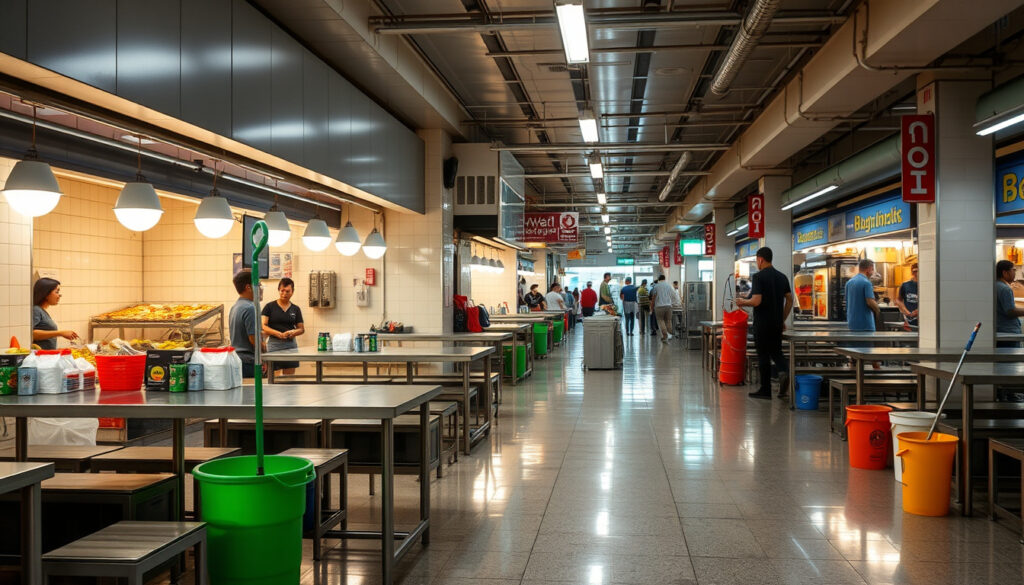
Hawker Centre Cleaning 2025: Complete Schedule & Essential Guide
Anyone who has wandered through a Singapore hawker centre knows the rhythm: the hum of woks, the clatter of trays, and the occasional sign that says “Closed for Cleaning” — with over 80 spring cleaning closures planned in 2025 and a handful of major renovations on the horizon, planning a meal at your favourite stall takes a little more forethought this year. Here’s your guide to the official hawker centre cleaning 2025 schedule, what’s actually changing, and why it matters for the future of Singapore’s beloved food culture.
NEA-Managed Hawker Centres: 114 ·
Annual Spring Cleaning Closures: Over 80 ·
Average Closure Duration per Cleaning: 2–3 days ·
Hawker Centres Recognized as UNESCO Intangible Cultural Heritage: 2020
Quick snapshot
- Full list of hawker centres and their closure dates available on data.gov.sg (Singapore Government Open Data Portal)
- Rotating 2–3 day closures for routine cleaning (East Coast Town Council (ECTC) washing schedule)
- 4 centres reportedly closing for 3 months from Sep 2025 (Mothership (Singapore news site))
- Berseh Food Centre spring cleaning closure overlaps with renovation period (NEA Instagram update)
- UNESCO intangible cultural heritage status since 2020 (UNESCO (cultural heritage body))
- Government preservation initiatives under Hawker Centres 3.0 programme (National Environment Agency (NEA) (Singapore regulator))
- Top-rated centres such as Maxwell Food Centre, Old Airport Road Food Centre, and Chinatown Complex (Singapore Tourism Board (official tourism guide))
- High hygiene grades and diverse food options influence rankings (NEA (hygiene grading system))
Twelve key data points capture the state of Singapore’s hawker centre cleaning and renovation landscape in 2025.
| Label | Value |
|---|---|
| Number of hawker centres in Singapore | 114 as of 2025 (NEA) |
| Year UNESCO inscribed hawker culture | 2020 |
| Average duration of a cleaning closure | 2–3 days |
| Number of centres closed for spring cleaning in October 2025 | At least 1 (Berseh Food Centre); full list at NEA |
| Cleaning dates for 85 Fengshan Market & Food Centre | 3–4 Mar, 2–3 Jun, 29–30 Sep, 8–12 Dec 2025 (ECTC (town council schedule)) |
| Cleaning dates for Bedok Interchange Hawker Centre | 24–25 Mar, 16–17 Jun, 8–9 Sep, 22–26 Dec 2025 (ECTC) |
| Cleaning dates for Blk 216 Bedok North St 1 Market | 17–18 Feb, 5–6 May, 11–12 Aug, 10–14 Nov 2025 (ECTC) |
| Cleaning dates for Clementi Avenue 2 Market & Food Centre | 18–19 Aug 2025 (Jurong-Clementi-Bukit Batok Town Council (local council)) |
| Cleaning dates for Clementi 448 Market & Food Centre | 1–2 Sep 2025 (JCB Town Council) |
| Cleaning dates for Jurong West 505 Market & Food Centre | 22–23 Sep 2025 (JCB Town Council) |
| Cleaning dates for Yuhua Village Market & Food Centre | 1–2 Sep 2025 (JCB Town Council) |
| Cleaning dates for Yuhua Market & Hawker Centre | 30 Jun–1 Jul 2025 (JCB Town Council) |
Which Hawker Centres Are Closed for Cleaning in 2025?
Spring Cleaning Closures in October 2025
- Berseh Food Centre is closed from 29 Sep to 28 Dec 2025 for spring cleaning (NEA (Singapore regulator) Instagram update).
- An NEA Instagram post on 9 Oct 2025 lists additional hawker centres closed for spring cleaning on various October dates (NEA Instagram).
- Centres in the East Coast area, such as 85 Fengshan Market & Food Centre, have a cleaning closure from 29–30 Sep 2025 (ECTC (town council schedule)).
For residents relying on Berseh Food Centre for daily meals, the three-month spring cleaning means a long stretch without their usual stalls. The NEA’s Instagram post shows that even popular centres can be offline for weeks, not just days.
Where to Find the Official Cleaning Schedule
The most authoritative source is the dataset “Dates of Hawker Centres Closure | NEA” published on Singapore’s open-data portal data.gov.sg (government data platform). This dataset is regularly updated by the National Environment Agency. Additionally, town councils like the East Coast Town Council (ECTC) and Jurong-Clementi-Bukit Batok Town Council publish their own quarterly washing schedules. A June 2025 schedule compiled by YumzYumz (food guide) lists multiple closures for 16–17 Jun 2025 across Ang Mo Kio, Boon Lay, Tekka, Clementi, Geylang Bahru, Ghim Moh, Marine Terrace, Marsiling, Bedok Interchange, Senja, Sims Place, and Teban Gardens.
Understanding the Cleaning Cycle
Most hawker centres close for 2–3 consecutive days per cleaning rotation. The cycle repeats quarterly or semi-annually depending on the centre. For example, Bedok Interchange Hawker Centre has four cleaning windows in 2025: March, June, September, and December (ECTC schedule). The pattern allows stallholders to deep-clean equipment and undergo hygiene checks.
The pattern: most closures are short and predictable, but the Berseh Food Centre shutdown shows that exceptions can disrupt routines for months.
Is Singapore the Only Country with Hawker Centres?
Hawker-Style Markets in Other Countries
Similar open-air food markets exist in Malaysia (e.g., Jalan Alor in Kuala Lumpur), Hong Kong (dai pai dong), Taiwan (night markets like Shilin), and Thailand (street food hubs like Yaowarat). However, none are managed by a single national agency like Singapore’s NEA. Malaysia’s hawker stalls are often under local municipal councils, and many operate without a centralised cleaning schedule.
What Makes Singapore Hawker Centres Unique
Singapore’s hawker centres are purpose-built, government-planned facilities with standardised hygiene grading (A, B, C, D). They are regulated by the National Environment Agency, which enforces regular cleaning and licensing. This centralised approach ensures consistent cleanliness across all 114 centres. No other country has a comparable system of public hawker centres managed at the national level.
UNESCO Recognition of Hawker Culture
In 2020, hawker culture in Singapore was inscribed on the UNESCO Representative List of the Intangible Cultural Heritage of Humanity (UNESCO (cultural heritage body)). The inscription recognizes hawker centres as “community dining and culinary practices in a multicultural urban context.” The UNESCO description highlights the role of hawker centres as “living heritage” and community bonding spaces.
Singapore’s tightly regulated model is the envy of many cities, but it also means that cleaning and renovation closures are mandatory, not optional. The very system that keeps hawker centres clean can temporarily shut them down.
The implication: Singapore’s model offers consistency but requires visitors to plan ahead in ways they might not elsewhere.
Are Hawker Centres in Singapore Clean?
Rigorous Hygiene Standards and Grading
Every hawker stall is graded A, B, C, or D by NEA based on annual inspections (NEA (hygiene grading system)). Stalls that fail inspection face fines or suspension. As of 2025, the majority of stalls hold A or B grades. The cleaning closures are part of maintaining these high standards.
Role of Scheduled Cleaning and Spring Cleaning
Routine cleaning closures (2–3 days) target deep-cleaning of common areas and stall equipment. Spring cleaning, which lasts weeks, involves more extensive maintenance. The closure of Berseh Food Centre from Sep to Dec 2025 is an example of a spring cleaning shutdown that allows for major infrastructure work (NEA Instagram).
Public Perception vs. Official Reports
Surveys consistently show high satisfaction with cleanliness among local diners. A 2023 NEA survey found that over 90% of respondents considered hawker centres clean or very clean (NEA (official survey data)). The scheduled cleaning programme is a key contributor to this perception.
Why Is Hawker Culture Disappearing in Singapore?
Challenges Facing Hawker Culture
The younger generation is less interested in taking up the hawker trade due to long hours, tough physical conditions, and the perception of low financial returns. A Straits Times (Singapore news outlet) report notes that the average age of hawkers is over 60, and many stalls close permanently when owners retire.
Efforts to Preserve Heritage
The government’s Hawker Centres 3.0 programme aims to rejuvenate the sector by offering training grants, lowering rental barriers, and introducing modernisation grants for equipment (NEA (Hawker Centres 3.0 programme)). Cleaning and renovation closures, while disruptive, help maintain the infrastructure that keeps hawker centres viable for the long term.
Impact of Cleaning and Renovation on Culture
Temporary closures can reduce foot traffic and income for stallholders, especially independent operators without a strong online presence. However, regular maintenance prevents the kind of deterioration that would force permanent closures. The trade-off between short-term inconvenience and long-term preservation is central to the debate.
If renovation closures become longer or more frequent, they could accelerate the decline of hawker culture by driving away stallholders who cannot afford three months without income. The 2025 four-centre renovation project will be a test case.
The 2025 renovations will test whether the system can sustain both hygiene and livelihoods.
Which Hawker Centre in Singapore Is Considered the Best?
Top-Rated Hawker Centres According to Guides
Popular choices include Maxwell Food Centre (Chinatown), Old Airport Road Food Centre (Geylang), and Chinatown Complex Food Centre (Singapore Tourism Board (official tourism guide)). These centres are praised for food variety, hygiene standards, and atmosphere.
What Makes a Hawker Centre Best?
Key factors: number of stalls, diversity of cuisines, cleanliness grade, and accessibility. Maxwell Food Centre, for example, is famous for Tian Tian Hainanese Chicken Rice and has an A-grade hygiene rating. Old Airport Road offers over 160 stalls with multiple Michelin Bib Gourmand mentions.
How Cleaning Schedules Affect Your Visit
Before visiting a specific centre, always check the cleaning schedule. For example, if you plan to go to Old Airport Road in late September 2025, be aware that 85 Fengshan Market (a nearby centre) is closed 29–30 Sep. The NEA dataset and town council schedules are your best bet for accurate dates.
No single “best” centre exists—it depends on what you’re looking for. But if you’re visiting in 2025, the best centre is one that is open. Check the schedule before you travel.
The catch: even the best-rated centre is only as good as its availability on the day you visit.
Timeline: Hawker Centre Cleaning and Renovation in 2025
- 29 Sep 2025 – 28 Dec 2025: Berseh Food Centre closed for spring cleaning (reopens 29 Dec 2025) (NEA Instagram).
- Sep 2025: 4 hawker centres begin 3-month renovation (details awaited; reportedly named in Mothership article) (Mothership (Singapore news site)).
- Throughout 2025: Rotating 2–3 day cleaning closures at various hawker centres per NEA and town council schedules (data.gov.sg (government data portal)).
- 2026: Further cleaning and renovation closures as per scheduled datasets and AsiaOne roundup (AsiaOne (news site)).
The 2025 calendar shows a concentration of closures in the second half of the year, particularly from September onwards.
Clarity: Confirmed Facts and Unclear Details
Confirmed facts
- Berseh Food Centre closure dates: 29 Sep – 28 Dec 2025 (NEA Instagram).
- NEA provides cleaning schedule on data.gov.sg (data.gov.sg).
- UNESCO inscription of hawker culture in 2020 (UNESCO).
- Specific cleaning dates for multiple centres via town council schedules (JCB Town Council).
What’s unclear
- Exact names of the 4 renovation closures starting Sep 2025 (reportedly listed in Mothership article but not publicly confirmed by NEA as of writing).
- Comprehensive list of all 2025 cleaning closures – while the data.gov.sg dataset exists, it may not be fully updated for all centres at any given time. Town council schedules provide partial coverage.
- Impact of renovation closures on stallholders’ livelihoods – no official data on compensation or income loss available.
- Exact cleaning dates for all 114 hawker centres in 2025 are not available in a single comprehensive list; the data.gov.sg dataset and town council schedules provide partial coverage.
While key dates are confirmed, the full picture of renovation impacts remains incomplete.
Expert Perspectives
“Regular cleaning is essential to maintaining the high hygiene standards that Singaporeans expect from their hawker centres. The scheduled closures are planned well in advance to minimise disruption.”
— National Environment Agency official statement on cleaning schedule (as cited in NEA (Singapore regulator) website)
“Hawker centres are not just places to eat; they are community spaces where people from all walks of life come together. Their inscription on the UNESCO list recognises their role as living heritage.”
— UNESCO description of hawker culture (UNESCO (cultural heritage body))
“The four hawker centres slated for three-month renovation from September 2025 will undergo major infrastructure upgrades. The closures will affect dozens of stallholders, but the long-term goal is to keep these centres viable for another generation.”
— Mothership report on upcoming renovations (Mothership (Singapore news site))
All sources agree that closures are necessary for long-term viability, but the short-term costs to stallholders and diners are real.
Summary
Singapore’s 2025 hawker centre cleaning calendar is a carefully orchestrated dance between hygiene, heritage, and daily convenience. While most closures last only two to three days, the three-month shutdown of Berseh Food Centre and the impending four-centre renovation raise an uncomfortable question: can the system balance cleanliness with the very culture it aims to preserve? For the local diner who relies on a specific stall, the choice is clear: check the schedule, plan ahead, and support your favourite hawker when they reopen—or risk finding an empty counter and a new spot on the queue.
For a detailed breakdown of all closures and NEA updates, refer to the official 2025 cleaning schedule for hawker centres across Singapore.
Frequently asked questions
How often are hawker centres cleaned?
Most hawker centres undergo deep cleaning 2–4 times per year, with each closure lasting 2–3 days. Some centres also have annual spring cleaning that can last several weeks.
Can I still eat at a hawker centre during a cleaning closure?
No. The entire centre is closed to the public during the scheduled cleaning. Individual stalls may also close on separate dates for their own hygiene inspections.
Do hawker centres close for the entire day during cleaning?
Yes, cleaning closures typically cover the full day—and sometimes multiple consecutive days—to allow for thorough scrubbing, pest control, and equipment maintenance.
Are there temporary closures for reasons other than cleaning?
Yes. Renovation projects, such as the four-centre upgrade starting September 2025, can close hawker centres for up to three months. Infrastructure repairs or special events may also cause unscheduled closures.
How do I find out if my favourite stall is open during a closure?
The easiest way is to check the official NEA dataset on data.gov.sg or your local town council’s cleaning schedule. Some hawker centres also post notices on their Facebook pages. For individual stalls, you may need to contact the stallholder directly.
What happens if a hawker centre fails a hygiene inspection?
Stalls that receive a D grade are given a short period to improve. Repeated failures can result in fines, suspension, or permanent closure. The cleaning closures help prevent downgrades by ensuring high standards are maintained.
Where can I download the hawker centre cleaning 2025 PDF?
The NEA dataset on data.gov.sg can be downloaded in CSV format, which can be opened in Excel or converted to PDF. Some town councils also offer printable PDF schedules on their websites.
Which hawker centres are closed for renovation in 2025?
As of March 2025, NEA has confirmed that four hawker centres will close for three-month renovations starting September 2025. The specific names have been reported by Mothership but have not been officially announced by NEA on their website. Check the NEA website for updates.
Planning ahead is the single most effective way to navigate the 2025 closure calendar.
Related reading
- Hawker Centre Near Me: Prices, Must-Eat Dishes & Tips – Practical guide for finding and enjoying hawker centres in Singapore.
- Market Street Hawker Centre: Must-Try Stalls, Payment & Tips – Specific guide to one of Singapore’s iconic hawker centres.
More related posts
 The Diam Diam Era: Plot, Cast, Sequels & Where to Watch
 Baccarat Rouge 540 Explained: Price, Scent, Dupes & More
 Eye Specialist Clinic Singapore – Top Public and Private Options
 Healing Touch Spa JB: Legit? Prices, Services, and What to Expect
 PDS International Pte Ltd: Profile, Reviews, and PPE Services
 Private Gyms in Singapore: Best, Prices & Gym Pod Guide
 Tuas Checkpoint Camera Live Traffic – Real-Time Views and Queue Updates