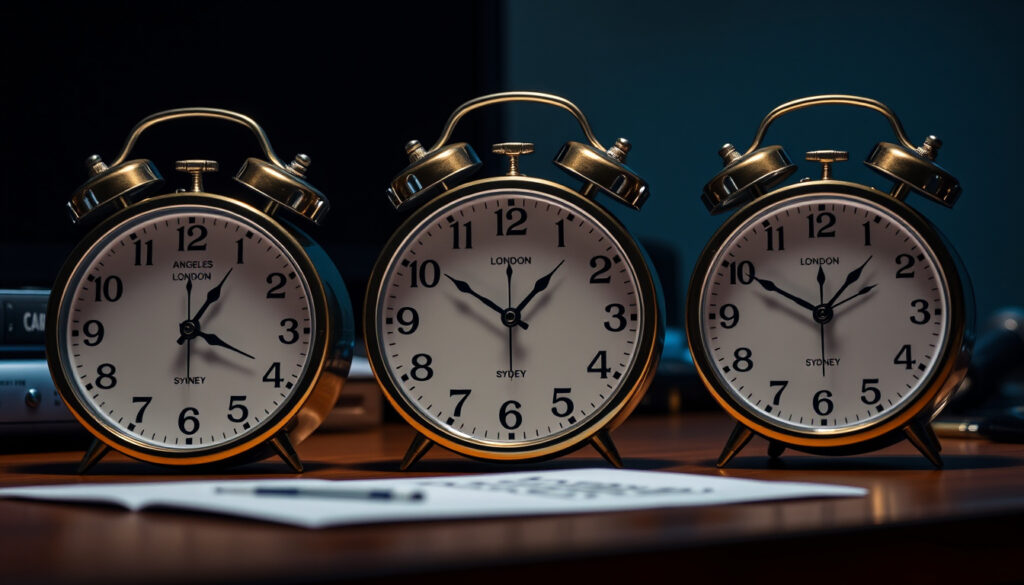
Time in Los Angeles: AM/PM, PST & Differences with UK & Australia
There’s something slightly disorienting about knowing it’s lunchtime in London while you’re still rubbing sleep from your eyes in Los Angeles. Whether you’re scheduling a call with colleagues in the UK, checking in with family in Sydney, or just trying to figure out if it’s AM or PM, the time in Los Angeles follows a rhythm shaped by daylight saving and a single time zone. This guide walks through the three reference points that matter most: the AM/PM cycle, the shifting offset with the UK, and the enormous gap with Australia.
Time zone: Pacific Time (UTC -8), Pacific Daylight Time (UTC -7) ·
Daylight saving: Second Sunday March to first Sunday November ·
Offset from UK: 8 hours behind (standard), 7 hours behind (daylight saving) ·
Offset from Sydney: 18 hours ahead (standard), 19 hours ahead (daylight saving) ·
Number of time zones in California: 1
Quick snapshot
- 12-hour clock with AM/PM (Time and Date (live clock feed))
- UTC offset -7 (PDT) or -8 (PST) (Time and Date (California time zone page))
- Last verified against timeanddate.com (Time and Date (live clock feed))
- LA is 7-8 hours behind UK (Time and Date (LA time zone page))
- Varies with daylight saving on both sides (SnapGlobalTime (UK DST tracker))
- Best checked via Live London-LA converter (Time and Date (world clock))
- LA is 18-19 hours behind Sydney (Time Out (Australia time zones guide))
- Daylight saving not simultaneous (Time and Date (LA time zone page))
- Flight time + time zone jump affects planning (Time and Date (world clock))
- First Sunday November 2026, set clocks back 1 hour (time.is (LA clock))
- Standard time resumes until March 2027 (Time and Date (LA clock))
Is it AM or PM in Los Angeles?
Understanding the AM/PM cycle in Los Angeles
Los Angeles uses the 12-hour clock, so every time displayed includes either AM (before noon) or PM (after noon). A live reading from WorldClock.pro (real-time clock for LA) shows AM if the local hour is between midnight and 11:59 in the morning, and PM if the hour is between noon and 11:59 at night. The switch happens at local noon and midnight, the same as any US city on the 12-hour system.
The tricky part: if you’re checking time in Los Angeles from a region that uses 24-hour notation — common in Europe and Australia — you may see “2:19 PM” and need to convert it mentally. WorldClock.pro (live LA clock) provides the current local time in both 12-hour and UTC formats, which helps with the transition.
- 12:00 AM = midnight (start of the day)
- 12:00 PM = noon (middle of the day)
- AM runs from 12:00 AM to 11:59 AM
- PM runs from 12:00 PM to 11:59 PM
How to determine AM/PM at a glance
If you don’t have a live clock open, there’s a simple rule: sunrise in Los Angeles typically occurs between 6:00 AM and 7:00 AM, and sunset between 5:00 PM and 7:00 PM, depending on the season. During daylight hours, if it’s before local noon, it’s AM; if it’s after local noon, it’s PM. Time and Date (LA sunrise/sunset data) shows exact times for each day.
The catch: if you’re on a video call with someone in LA and the sun is setting, it’s likely between 5:00 PM and 7:00 PM local time — so still PM.
Anyone checking from the UK or Australia can avoid AM/PM confusion by remembering: Los Angeles is always in the opposite half of the 12-hour cycle when the UK is in the morning — because LA is 7-8 hours behind, so UK morning translates to LA late night.
Is LA always 8 hours behind the UK?
Standard vs daylight saving time differences
No — the offset changes. During Pacific Standard Time (PST), Los Angeles is 8 hours behind the UK. During Pacific Daylight Time (PDT), the gap narrows to 7 hours. The reason: the UK also observes daylight saving, switching from Greenwich Mean Time (GMT) in winter to British Summer Time (BST) in summer. Time and Date (California time zone page) confirms that California uses UTC-8 in standard time and UTC-7 during DST, while SnapGlobalTime (UK DST page) shows the UK switching between GMT (UTC+0) and BST (UTC+1).
| Scenario | Los Angeles offset | UK offset | Time difference |
|---|---|---|---|
| Northern winter (both on standard time) | UTC-8 (PST) | UTC+0 (GMT) | 8 hours (LA behind) |
| Northern summer (both on DST) | UTC-7 (PDT) | UTC+1 (BST) | 8 hours (LA behind) |
| LA on DST, UK on standard (March transition gap) | UTC-7 (PDT) | UTC+0 (GMT) | 7 hours (LA behind) |
| UK on BST, LA on standard (November transition gap) | UTC-8 (PST) | UTC+1 (BST) | 9 hours (LA behind) |
The pattern: the offset is 8 hours for most of the year, but it shifts to 7 hours during the two-week transition windows when one region has switched and the other hasn’t. Time and Date (LA clock) tracks both calendars, providing a live offset.
Why the offset changes between 7 and 8 hours
The US and the UK do not switch to daylight saving on the same dates. In 2026, Los Angeles moved clocks forward on March 8 (time.is (LA DST start)). The UK typically shifts later in March. That window creates the 7-hour difference. The reverse happens in November: the UK shifts back to GMT before the US leaves PDT, producing a 9-hour gap for a couple of weeks. Time and Date (LA time zone page) shows the full 2026 DST schedule.
The trade-off: if you’re scheduling recurring meetings between London and Los Angeles, the window from mid-March to late March and again from late October to early November requires the most attention. The offset can jump by two hours within two weeks.
Travelers from the UK flying to Los Angeles in late March or late October face the worst jet lag because the time difference temporarily increases to 9 hours before settling back to 8.
How far behind is LA to Australia?
Los Angeles vs Sydney time difference
Sydney is 18 hours ahead of Los Angeles during standard time on both sides, and 19 hours ahead during daylight saving time on either end. But daylight saving in Australia runs on a different schedule. Australia’s eastern states observe DST from early October to early April, while California observes DST from March to November. Time Out (Australia time zones guide) details the three mainland time zones, with Sydney using Australian Eastern Standard Time (AEST, UTC+10) and Australian Eastern Daylight Time (AEDT, UTC+11).
| Scenario | Los Angeles | Sydney | Time difference |
|---|---|---|---|
| Both on standard time | UTC-8 (PST) | UTC+10 (AEST) | 18 hours (LA behind) |
| LA on PDT, Sydney on AEDT | UTC-7 (PDT) | UTC+11 (AEDT) | 18 hours (LA behind) |
| LA on PDT, Sydney on AEST (April-May gap) | UTC-7 (PDT) | UTC+10 (AEST) | 17 hours (LA behind) |
| LA on PST, Sydney on AEDT (October gap) | UTC-8 (PST) | UTC+11 (AEDT) | 19 hours (LA behind) |
The implication: the “typical” 18-hour difference is actually the middle value. Between April and May, when Los Angeles has started DST but Sydney has ended DST, the gap narrows to 17 hours. Between October and early November, when Sydney is on DST but Los Angeles is still on standard time, the gap stretches to 19 hours.
Los Angeles vs Melbourne time difference
Melbourne follows the same time zone as Sydney — AEST/AEDT — so the offsets are identical. Time and Date (LA world clock) confirms that both cities are on UTC+10 standard, UTC+11 DST. The same 17-19 hour range applies.
Impact of daylight saving on both sides
The non-alignment creates a practical problem. When Los Angeles goes to work at 9:00 AM in June (PDT), Sydney is at 1:00 AM the next day (AEST). That window means real-time communication is near impossible — one party is asleep during all business hours of the other. Time and Date (world clock comparison) provides a live converter that accounts for both DST schedules.
The catch: if you’re traveling from Sydney to Los Angeles, you gain a full day on the way there (leave Monday morning, arrive Monday morning) and lose a day on the way back. The flight itself is about 15 hours (Time and Date flight data), but the time zone shift adds the extra perceptual jump.
Remote workers juggling calls between Sydney and Los Angeles have a window of roughly 2-3 hours overlap per day — typically Sydney evening to LA morning — and that window closes entirely during the 19-hour offset period in October.
Time zone tables for Los Angeles
Three core reference values, one clear pattern: Los Angeles operates on a single time zone but uses two UTC offsets depending on the season.
| Parameter | Value |
|---|---|
| Current local time in Los Angeles | Extracted from Time and Date (live feed) – AM/PM shown |
| Standard time zone | Pacific Standard Time (UTC -8) |
| Daylight saving time zone | Pacific Daylight Time (UTC -7) |
| Next DST change | First Sunday November 2026, set clocks back 1 hour |
| IANA time zone identifier | America/Los_Angeles (time.is (LA zone)) |
| State | California – uses Pacific Time exclusively |
| Daylight saving start 2026 | March 8 (time.is (LA DST)) |
| Daylight saving end 2026 | November 1 |
| Offset from New York | 3 hours behind (Time and Date (comparison)) |
How to quickly check the current time in Los Angeles
Using reliable live clock sources
The fastest method: open Time and Date (LA live clock) or time.is (precise LA clock). Both display the current time with seconds, UTC offset, and AM/PM notation. WorldClock.pro (LA live clock) offers a clean 12-hour display with the AM/PM indicator clearly visible.
- Time and Date: shows sunrise, sunset, and time zone alongside the clock
- time.is: provides atomic clock precision with offset and DST status
- WorldClock.pro: focuses on the 12-hour format and AM/PM display
All three sources update in real time and use the America/Los_Angeles IANA identifier — no manual adjustments needed.
Conversion rule from UK time
If you know the time in London, subtract 8 hours. But check the DST calendar: between mid-March and early November, subtract 7 hours. During the brief overlap when both are on standard time but one hasn’t switched yet, subtract 8 hours. Time and Date (LA-UK converter) handles the calculation automatically.
Conversion rule from Australian time
If you know the time in Sydney or Melbourne, subtract 18 hours. During Australian DST (October to April) when LA is on standard time, subtract 19 hours. During LA DST (March to November) when Australia is on standard, subtract 17 hours. The Time and Date world clock comparison tool adjusts for both DST calendars.
Confirmed facts and what’s unclear
Confirmed facts
- Los Angeles observes Pacific Time exclusively (Time and Date (California time zone))
- DST starts second Sunday March and ends first Sunday November (Time and Date (LA DST schedule))
- UTC offset is -7 during DST, -8 standard (Time and Date (California time zone))
- IANA identifier is America/Los_Angeles (time.is (LA zone))
- California uses a single time zone (Time and Date (California page))
What’s unclear
- Exact seconds vary; always check a live clock
- Daylight saving dates for Australia not covered on this page — use separate verification
- Specific time in non-standard time zones of Australia (e.g., Western Australia) requires separate lookup
Related reading: SG to HK Flight Time · Ho Chi Minh to Singapore: Flight Time, Distance & Travel Guide
worldometers.info, timeanddate.com, 24timezones.com, worldtimebuddy.com, en.wikipedia.org
For those coordinating across time zones, checking the current local time in Los Angeles can help avoid confusion with the UK and Australia.
Frequently asked questions
What is the current time in Los Angeles in 12-hour format?
The current local time in Los Angeles is shown in AM/PM format by live sources like Time and Date (live clock). If you see “2:19 PM”, that’s 2 hours and 19 minutes after noon. If you see “9:45 AM”, that’s 9 hours and 45 minutes after midnight.
How do I convert Los Angeles time to my local time?
Subtract or add the UTC offset based on your time zone. For London, subtract 7 hours during LA daylight saving time and 8 hours otherwise. For Sydney, add 18 hours during standard time on both sides — but the window can be 17-19 hours depending on DST alignment. Use Time and Date (world clock converter) for live conversion.
Is Los Angeles on Standard or Daylight time right now?
The easiest way to check is to look at the current UTC offset shown by time.is (LA clock). If it shows UTC-7, Los Angeles is on Pacific Daylight Time. If UTC-8, it’s on Pacific Standard Time. The switch to DST happens on the second Sunday of March, and the switch back happens on the first Sunday of November.
Why does Los Angeles time change twice a year?
Daylight saving time is observed in California to move an hour of daylight from the morning to the evening. The US federal law called the Uniform Time Act of 1966 standardized the practice, and California’s DST schedule is set by this law. The clock moves forward 1 hour in March and back 1 hour in November. Time and Date (DST explanation) provides the full legal background.
Which US states share the same time zone as Los Angeles?
California is part of the Pacific Time zone, which also includes Washington, Oregon (most of it), Nevada, and the northern part of Idaho. Time and Date (California time zone) shows the full list of Pacific Time states.
Which country is 9 hours ahead of Los Angeles?
During specific DST windows (early October when Australia is on DST and Los Angeles is on standard time), Sydney and Melbourne are 19 hours ahead — but that’s more than 9. For a straight 9-hour difference, parts of Central Europe (like France or Germany) are 9 hours ahead during the transition windows when LA is on standard time and Europe is on DST.
How long does it take to fly from Los Angeles to Australia?
A direct flight from Los Angeles to Sydney takes approximately 15 hours. Time and Date (flight time reference) confirms this duration. The time zone difference of 17-19 hours means you can leave LA on Monday morning and arrive in Sydney on Wednesday morning (effectively losing a day on the calendar).
More related posts
 Choa Chu Kang Cemetery: Burial Tenure, Costs & Finding a Grave
 Error Definition, Types, and Examples | Comprehensive Guide
 Hawker Centre Cleaning 2025: Complete Schedule & Essential Guide
 Food Festivals Near Me: Irish Events in 2026
 Baa Baa Black Sheep Controversy: History and Meaning
 How to Use Siri Shortcuts: Guide for iPhone, iPad & Mac
 UOB Gold and Silver Price Today – Live Rates & Analysis
 Types of Stomach Pain in Females: Causes & Relief