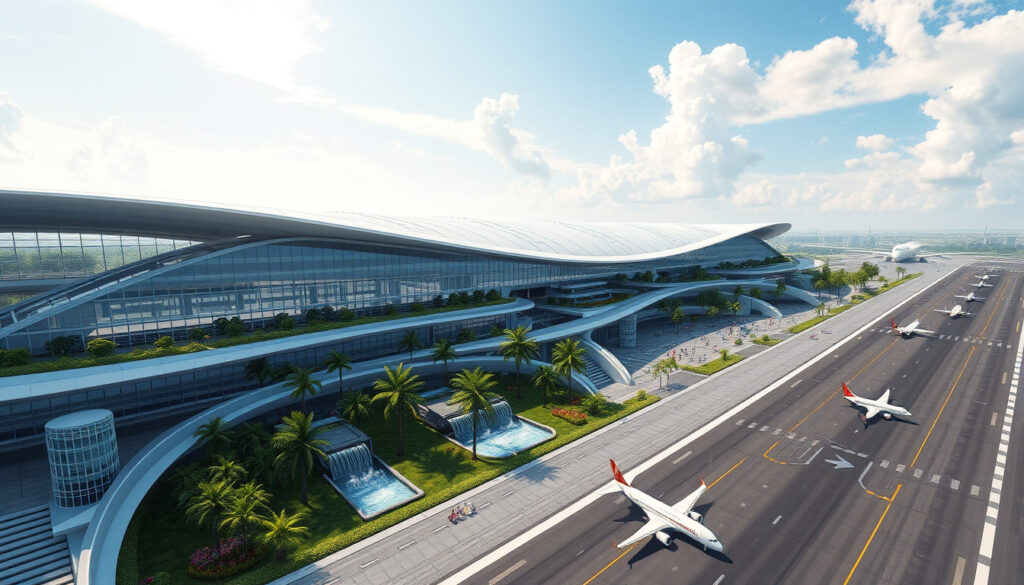
Singapore Changi Airport Terminal 5: Plans, Design & Opening
If you’ve ever transited through Singapore’s Changi Airport, you know the standard most terminals worldwide aspire to. Now Singapore is raising the bar again with Terminal 5 — a massive new hub carved out of the Changi East development that will eventually handle 50 million passengers annually in its first phase alone. Whether you’re a frequent flyer, an aviation enthusiast, or simply planning a future trip, here’s what the numbers, timelines, and design choices actually mean.
Capacity: 50 million passengers per year · Opening: mid-2030s · Designers: Heatherwick Studio and KPF · Part of: 1,080-hectare Changi East Development
Quick snapshot
- 50 million annual passengers in Phase 1 (Changi Airport Group)
- Groundbreaking held on 14 May 2025 (Mott MacDonald)
- 1,080-hectare Changi East district (Changi Airport Group)
- Which airlines will operate from T5
- Exact MRT station opening year
- Main construction contractor
- PM Lawrence Wong announced construction start (September 2024)
- Two contracts worth S$4.5 billion awarded (May 2025)
- T5 exhibition opened (January 2026)
- Terminal operations launch in mid-2030s
- MRT station expected around 2040
- Connections to existing Terminals 1–4 via tunnels
The specifications below distil the key parameters that define Singapore’s most ambitious aviation infrastructure project to date.
| Specification | Detail |
|---|---|
| Status | Under development |
| Expected Capacity | 50 million passengers/year (Phase 1) |
| Opening Target | Mid-2030s |
| Groundbreaking | 14 May 2025 |
| Architects | Heatherwick Studio, KPF, architects61 |
| Location | Changi East |
| District Area | 1,080 hectares |
| Post-T5 Total Capacity | 140 million passengers/year |
| Runways | Three (including new third runway) |
| Taxiways | 40 kilometres |
What is Changi Terminal 5 for?
Singapore built its reputation on being the aviation hub that other countries measure themselves against. Terminal 5 is the next chapter — a facility designed not just to add capacity but to absorb the kind of growth that will double the airport’s throughput by the 2040s. In its first phase, T5 alone will handle 50 million passengers annually, a number that surpasses the total annual traffic of many major international airports. When fully built out, the Changi East development will lift the airport’s ceiling to 140 million passengers per year.
Role in Changi East Development
Changi East isn’t simply a new terminal — it’s a 1,080-hectare aviation district that weaves together aircraft operations, cargo logistics, business zones, and green urban planning. According to TheDesignAir (aviation design publication), the district will eventually support three runways, 40 kilometres of taxiways, an air cargo hub, aircraft maintenance facilities, and a business-lifestyle precinct. The airfield sits at 5.5 metres above sea level — a deliberate elevation choice to withstand increasingly extreme weather patterns, as documented by Mott MacDonald (engineering consultancy).
The implication: Changi is building an aviation city, not just a terminal, positioning Singapore to absorb regional traffic growth for decades.
Capacity Expansion
Current Changi capacity stands at roughly 90 million passengers per year across Terminals 1 through 4. The addition of T5 pushes that figure to 140 million — a 56% increase — without requiring passengers to choose between outdated and modern facilities. The Straits Times (Singapore’s leading newspaper) reported that T5’s Phase 1 capacity exceeds half of what all four existing terminals handle combined.
What is clear is the intent: T5 exists to serve growing demand across the network, giving low-cost carriers and full-service airlines alike room to expand routes that the existing terminals cannot accommodate.
Which airlines will use Changi Terminal 5?
This is the question visitors to the public exhibition ask most often, and it’s also the one with the least public information. Changi Airport Group has not announced a specific airline allocation for T5, and airport operators typically confirm such arrangements years in advance. What is clear is the intent: T5 exists to serve growing demand across the network, giving low-cost carriers and full-service airlines alike room to expand routes that the existing terminals cannot accommodate.
Planned Airline Allocation
Airport sources indicate that airlines will be assigned to T5 based on route growth patterns, fleet expansion plans, and bilateral air services agreements that Singapore negotiates with other countries. As reported by Wikipedia (citing aviation infrastructure records), Transport Minister S Iswaran stated in 2022 that T5 would be designed to flexibly match traffic growth rather than locking in a fixed airline configuration from the start.
Comparison to Current Terminals
Today, Singapore Airlines and Scoot primarily operate from Terminals 2 and 3, while other carriers use Terminal 1 and the recently expanded Terminal 4. T5’s scale — comparable to some of the world’s largest single-terminal airports — suggests it could absorb a significant portion of Singapore Airlines’ future growth or provide dedicated facilities for a major alliance partner. The ground transportation centre included in T5’s design will handle connections regardless of which terminal a passenger’s airline uses.
When is the Singapore Changi Airport Terminal 5 opening date?
The official line from Changi Airport Group (airport operator) is “mid-2030s” — a window the authority has held consistently since the project was announced. This is deliberately broad: airport terminals of this scale rarely open on a single target date; they phase into service, test systems, and transition airlines in sequence. The groundbreaking in May 2025 started the clock, but a terminal of T5’s complexity typically requires a decade from first contract to first passenger.
Completion Timeline
Several concrete milestones anchor the timeline. Prime Minister Lawrence Wong announced in September 2024 that construction would begin in the first half of 2025 — a statement that was borne out when groundbreaking took place on 14 May 2025, with Wong officiating. During Budget 2025, the government allocated an additional S$5 billion for Changi expansion, as documented by Wikipedia (Singapore budget records). Two major contracts worth a combined S$4.5 billion were awarded in May 2025, followed by a S$999 million tunnel contract in June 2025.
Construction Milestones
What’s notable is how much preparation happened before the groundbreaking. The third runway, vehicular underpass, and tunnel connections to existing terminals were substantially completed before the official ceremony. Channel News Asia (Singapore’s broadcaster) reported that major tunnelling work connecting T5 to Terminal 3 was finished ahead of schedule. A public exhibition titled “T5 In the Making” opened at Terminal 3’s Arrival Hall on 6 January 2026, giving visitors a preview of the construction process and design philosophy.
What is the design of Singapore Changi Airport Terminal 5?
Few airport projects have generated as much design attention as T5. The team behind it — Heatherwick Studio, Kohn Pedersen Fox (KPF), and Singapore-based architects61 — represents a rare collaboration between a studio famous for organic, nature-inspired structures and a global firm specialising in airport terminals. The result, according to the architects, is a terminal that feels intimate despite its scale.
Architects Involved
Designboom (architecture publication) documented the team structure: KPF serves as design architect, Heatherwick Studio contributes the public experience and materiality, and architects61 handles local delivery and technical integration. This is the third project Heatherwick Studio has undertaken in Singapore, following the award-winning Cloud Valley sculpture garden and the Mandai Wildlife Bridge.
Key Features
The defining visual element is the roof — a series of overlapping curved “roof leaves” at varying heights that create a human-scale, intimate atmosphere in a structure that would otherwise read as a warehouse. Changi Airport Group (airport operator) describes the intent as bringing the outdoors inside, drawing on Singapore’s reputation as a city where nature and urban life interlock. KPF Design Principal Trent Tesch told TheDesignAir (aviation design publication) that the terminal is “inspired by Singapore’s unique blend of nature and city.”
Beyond aesthetics, T5 incorporates advanced automation for baggage and passenger processing, green building principles to reduce operational energy, and an intuitive wayfinding architecture that reduces the cognitive load on first-time travellers. Buildings within the terminal complex connect via an automated people mover system, as noted by Mott MacDonald (engineering consultancy).
Heatherwick projects are known for creating spaces people actively seek out, not just pass through. If T5 delivers on that promise, it won’t just handle passengers — it could become a destination in its own right, raising the bar for what airport design is expected to achieve globally.
Changi Airport Terminal 5 connectivity and transit
A terminal only works if passengers can actually reach it. T5’s connectivity plan weaves together MRT rail links, ground transportation, and pedestrian tunnels to existing terminals — but the timeline for MRT access is the detail that requires the most patience.
MRT Access
TheDesignAir (aviation design publication) reported that the T5 MRT station is expected to be operational around 2040, serving the Cross-Island Line and Thomson-East Coast Line. That date is roughly five to seven years after T5’s opening — a gap that will initially be bridged by bus and automated people mover connections. Passengers should not expect to step off an MRT directly into T5 on day one.
Walking Between Terminals
The passenger and baggage tunnel system connecting T5 to the existing terminal cluster was substantially completed before the groundbreaking. Channel News Asia (Singapore’s broadcaster) confirmed that major tunnelling work linking T5 to Terminal 3 is finished, meaning transferring passengers will be able to walk between terminals without re-clearing security — a significant quality-of-life improvement for connecting travellers.
Transit Rules
Singapore’s transit rules for airport connections are relatively traveller-friendly. The 60/90 rule — which allows eligible passengers up to 90 days of social visits without a visa — does not affect transit itself but is relevant for planning extended stays. For passengers transiting through Changi, the airport’s free city tour and transit hotel facilities remain available regardless of which terminal a flight departs from.
The MRT timeline gap is the one connectivity issue that could frustrate early T5 users accustomed to the Changi Airport MRT station serving Terminals 1–4 directly. Monitor Land Transport Authority announcements around 2031–2032 for construction milestones that will confirm the 2040 target.
Timeline
Eight milestones mark T5’s journey from announcement to operation.
Transport Minister S Iswaran announces T5 construction to begin in 2–3 years, with operations targeted for the mid-2030s
Prime Minister Lawrence Wong announces construction will start in the first half of 2025
Budget 2025 allocates S$5 billion for Changi expansion including T5
Groundbreaking ceremony officiated by PM Lawrence Wong; two contracts worth S$4.5 billion awarded
S$999 million tunnel contract awarded
“T5 In the Making” exhibition opens at Terminal 3 Arrival Hall, free with registration
MRT station serving Cross-Island and Thomson-East Coast lines expected operational
T5 opens for passenger operations
Clarity on what we know — and what we don’t
With any large infrastructure project, public knowledge evolves as phases complete. Here is where the facts stand on firm ground versus where gaps remain.
Confirmed
- Phase 1 capacity: 50 million passengers per year
- Opening window: mid-2030s
- Design team: Heatherwick Studio, KPF, architects61
- Groundbreaking: 14 May 2025
- District size: 1,080 hectares
- Total post-T5 capacity: 140 million
- Roof design: overlapping curved leaves
- Three runways, 40 km taxiways
- Tunnels to existing terminals substantially complete
- Public exhibition running at Terminal 3
Unclear
- Which airlines will operate from T5
- Exact opening year (2024–2037 window)
- MRT station precise opening date
- Main construction contractor identity
- Detailed construction cost breakdown beyond major contracts
- Environmental impact assessment findings
- Specific sustainability certifications targeted
What people are saying
T5 can turbocharge Singapore’s air hub status.
— Prime Minister Lawrence Wong, at the groundbreaking ceremony, May 2025
Inspired by Singapore’s unique blend of nature and city.
— Trent Tesch, KPF Design Principal, in an interview with TheDesignAir
Terminal 5 will be operational by the mid-2030s, to meet an anticipated doubling of volume by the 2040s.
— Transport Minister S Iswaran, May 2022
The consistent thread across government statements is ambition matched by financial commitment. The S$5 billion Budget 2025 allocation, the S$4.5 billion in awarded contracts, and the Prime Minister’s personal officiation at the groundbreaking signal that T5 is not a speculative project — it is a funded, politically backed commitment with clear milestones.
When the Prime Minister calls T5 a “turbocharge” for Singapore’s hub status at an official ceremony, that language reflects cabinet-level priority. Projects with this level of political investment tend to receive priority resourcing through delays, cost overruns, or scope changes.
Related reading: Changi Airport Terminal 3 Map · Singapore to Australia Flight
youtube.com, passengerterminaltoday.com, youtube.com, airportindustry-news.com, heatherwick.com
Terminal 5’s added capacity will support booming long-haul demand, much like Singapore Airlines’ SQ23 to New York that links Changi directly to JFK nonstop.
Frequently asked questions
Is Changi Terminal 5 open yet?
No. T5 is under construction. The groundbreaking took place on 14 May 2025, and operations are targeted for the mid-2030s. A public exhibition at Terminal 3 gives visitors a preview of the design and construction progress.
How will Terminal 5 connect to other Changi terminals?
T5 links to existing Terminals 1 through 4 via passenger and baggage tunnels. Major tunnelling work was substantially completed before the groundbreaking. Within T5 itself, buildings are connected by an automated people mover system.
What transit rules apply at Singapore Changi Airport?
Singapore allows visa-free entry for citizens of most countries for stays up to 90 days under the 60/90 rule. Transiting passengers who do not clear immigration can use Changi’s transit facilities, including free city tours and the airport hotel, without entering Singapore proper.
Which terminal is best at Changi Airport currently?
Terminal 3 handles the most Singapore Airlines and Scoot flights and offers the widest dining and retail options. Terminal 4 is smaller and more efficient for low-cost carriers. Terminal 1 recently completed a major refurbishment. Terminal 2 is the most recently renovated.
How early should I arrive for Terminal 5 flights?
Once T5 is operational, travellers should follow standard Changi guidance: three hours for international departures, two hours for transit within the same terminal. Allow additional time if connecting between T5 and the older terminals via the tunnel system.
More related posts
 Who Won the 2025 Irish Presidential Election Results
 Where to Watch Anime: Best Streaming Services Compared
 Eye Specialist Clinic Singapore – Top Public and Private Options
 Food High in Iron – Top Sources and Absorption Tips
 Part Time Jobs in Tampines: No Experience, Weekend & Evening
 Best Virtual Museum Tours: Free, 360, & Top Picks for 2025
 Nearest Polyclinic Singapore: Walk-In, Costs & Hours