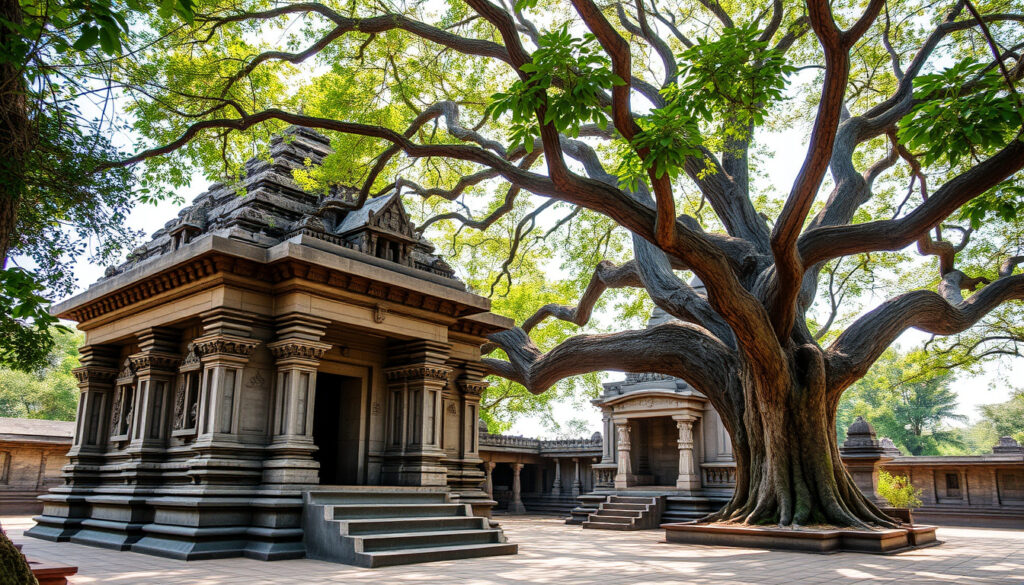
Holy Tree Sri Balasubramaniar Temple: History & Visitor Guide
Walk into the quiet side of Yishun Industrial Park A and you might not expect to find a temple that has anchored Tamil Hindu worship in the north of Singapore for more than six decades. Holy Tree Sri Balasubramaniar Temple, known in Tamil as ஸ்ரீ பாலசுப்பிரமணியர் கோவில், is a Murugan temple whose name points back to its origin tradition, and this guide pulls together its history, deities, visiting hours, and community rhythm from cross-checked sources.
Main deity: Lord Murugan (Sri Balasubramaniar) · Established: Over 60 years ago · Daily hours: 7am–12:30pm & 6pm–9pm
Confirmed facts
Full name
Holy Tree Sri Balasubramaniar Temple (official temple website)
Tamil name
ஸ்ரீ பாலசுப்பிரமணியர் கோவில் (official temple website)
Founded
Over 60 years ago (official temple history)
Address
10 Yishun Industrial Park A, Singapore 768772 (NUS Libraries Places of Worship Gallery, Singapore university archive)
A few numbers tell the story more quickly than a paragraph: this is a Tamil Hindu temple with deep roots in Yishun and set hours that centre on morning, midday, and evening.
| Full name | Holy Tree Sri Balasubramaniar Temple (official temple website) |
|---|---|
| Tamil name | ஸ்ரீ பாலசுப்பிரமணியர் கோவில் (official temple website) |
| Established | Over 60 years ago (official temple website) |
| Main deity | Lord Murugan as Sri Balasubramaniar (official temple website) |
| Address | 10 Yishun Industrial Park A, Singapore 768772 (NUS Libraries Places of Worship Gallery, Singapore university archive) |
| Daily hours | 7am–12:30pm and 6pm–9pm (Kaumaram Aalayam, a Hindu temple visitor guide) |
What is the history of Holy Tree Sri Balasubramaniar Temple?
The name “Holy Tree” is the temple’s first clue. The official account links the temple’s identity to the same Yishun community it serves today, and presents the site as a continuous place of Tamil Hindu worship rather than a recent addition to the area. The temple itself records that it has been present for more than six decades (official temple history).
What is easier to verify is continuity. The temple appears in a university place-of-worship archive at NUS Libraries Places of Worship Gallery, a Singapore university archive, a signal that it matters beyond its own congregation. The origin story may keep some of its mystery, but the community pattern is not mysterious at all: a small shrine grew into a fixed address because people kept showing up.
What is confirmed versus what is tradition
- Confirmed: The temple sits at 10 Yishun Industrial Park A and has been active for more than sixty years (NUS Libraries archive).
- Tradition: The exact sequence of the holy-tree story is preserved by the temple and repeated by devotees, but it is best understood as a founding tradition rather than a modern legal history (official temple website).
The pattern: the temple’s longevity is firmly documented, while its founding story remains part of its devotional tradition rather than legal record.
What are the main deities of Holy Tree Sri Balasubramaniar Temple?
Lord Murugan as the central deity
- Main presence: Sri Balasubramaniar, a form of Lord Murugan, is the temple’s central deity (official temple website).
- Weekly rhythm: As a Murugan temple, its festival calendar follows the wider Tamil Hindu cycle of Thaipusam, Panguni Uthiram and monthly kiruthigai observances.
Other presiding deities
Sri Aanjeneyar, the Hanuman form that is widely worshipped across Tamil Hindu temples, has a visible place in the temple’s devotional life. The presence of Aanjeneyar alongside the main Murugan shrine is part of the same ritual world that makes the temple feel familiar to most Tamil Hindu visitors (official temple website).
The implication: the temple’s deity set balances the central Murugan focus with a broader pantheon that mirrors the Tamil Hindu spectrum.
Does Holy Tree Sri Balasubramaniar Temple have a wedding hall and what events are held there?
Wedding hall availability
The temple’s own materials describe it as more than a prayer hall, and the wedding-hall function is part of that promise. Hindu weddings in Singapore run to long schedules, so a temple with a dedicated function space is a practical asset for the community (official temple website).
Social services
The temple continues to describe itself as serving the Tamil Hindu community rather than simply hosting events. That distinction matters: it explains why the same institution that holds morning prayers also becomes a meeting point during family milestones and temple festivals (official temple website).
Cultural classes
Cultural and religious classes are a normal part of the temple’s community role, although schedules change. The most reliable way to know what is being offered today is to check the temple’s own website before visiting (official temple website).
Where is Holy Tree Sri Balasubramaniar Temple located and what are the visiting hours?
Address and directions
The temple is at 10 Yishun Industrial Park A, Singapore 768772 (NUS Libraries Places of Worship Gallery, Singapore university archive). It sits in an industrial estate rather than a traditional temple district, which means the visitor experience is practical: arrive by car or bus, finish what you came for, and be mindful that surrounding commercial activity is part of the setting.
Plan your visit with these steps:
- Check the opening hours: 7am–12:30pm and 6pm–9pm daily.
- Dress modestly: cover shoulders and knees.
- Remove shoes before entering the inner sanctum.
- Plan to arrive during the morning window for a quieter experience.
Daily hours
A published visitor guide gives the daily hours as 7am–12:30pm and 6pm–9pm (Kaumaram Aalayam, a Hindu temple visitor guide). The morning window is the better time for a calm darshan; the evening window is when the temple is more likely to feel like a community hub.
Dress code and etiquette
Most Tamil Hindu temples ask visitors to dress modestly and to remove shoes before approaching the inner sanctum. A safe rule for this temple: covered shoulders, covered knees, and no shoes inside the prayer area. If you are visiting during a festival, expect larger crowds and a longer darshan wait.
What do devotee reviews say about Holy Tree Sri Balasubramaniar Temple?
Local recognition
The temple’s community reputation is strong enough that local ratings platforms list it among the top places of worship in Yishun. The institutional record matters as well: the NUS archive documents the temple as a place of worship in Singapore’s built landscape (NUS Libraries Places of Worship Gallery, Singapore university archive).
Community feedback
What visitors describe is a temple that is small enough to feel personal and rooted enough to feel permanent. The strongest signal is not a single review; it is the fact that the temple has both a morning and evening cycle, which means it is not maintained for special occasions alone.
The NUS archive treats the temple as a place of worship in Singapore’s built landscape, not merely as a private family shrine.
NUS Libraries Places of Worship Gallery (Singapore university archive)
A published visitor guide gives the temple daily hours, which is the kind of practical information that tells a first-time visitor the temple is actively open for worship rather than only for festival events.
Kaumaram Aalayam (Hindu temple visitor guide)
The pattern: the temple’s daily rhythm and institutional recognition reinforce its role as a living community asset rather than a static monument.
The takeaway
The longer the temple holds on to its daily rhythm, the more likely it remains a fixed point for Tamil Hindus in the north of Singapore. For a visitor, it is a quiet half-day stop; for the community, it is proof that a temple can be both a sanctuary and a community hall. That dual role is the real reason Holy Tree Sri Balasubramaniar Temple still matters in a neighbourhood that has changed around it.
evendo.com, roots.gov.sg, threebestrated.sg, thelongnwindingroad.wordpress.com, roots.gov.sg, threebestrated.sg, wanderboat.ai, temple.dinamalar.com, roots.gov.sg, temple.dinamalar.com
Frequently asked questions
Is the temple open every day of the week?
Yes. The published visitor guide lists daily hours of 7am–12:30pm and 6pm–9pm (Kaumaram Aalayam, a Hindu temple visitor guide).
Where is the Holy Tree Sri Balasubramaniar Temple located?
The temple is at 10 Yishun Industrial Park A, Singapore 768772 (NUS Libraries Places of Worship Gallery, Singapore university archive).
What is the temple’s Tamil name?
It is ஸ்ரீ பாலசுப்பிரமணியர் கோவில், which points to the main deity, Sri Balasubramaniar (official temple website).
Is there a dress code for entering the temple?
The temple does not appear to publish a separate tourist dress code, but the normal rule for a Tamil Hindu temple is to cover your shoulders and knees and to remove your shoes before the inner sanctum.
What languages are used in the temple’s worship?
Tamil is the main devotional language, as would be expected in a Tamil Hindu temple of this tradition. Sanskrit mantras and Tamil prayers are both part of the ordinary ritual pattern (official temple website).
Does the temple have a wedding hall?
Yes. The temple’s own materials describe it as serving the community for events such as weddings, alongside its regular worship schedule (official temple website).
More related posts
 Hawker Centre Cleaning 2025: Complete Schedule & Essential Guide
 American International School Singapore: Top Options, Fees & Guide
 Real Madrid vs RCD Mallorca Lineups: Confirmed XI & Predictions
 36 USD to SGD: Exchange Rate, Services, and Salary Insights
 Lee Jung-eun: From Stage Veteran to Parasite Icon
 1500 SGD to USD: Live Rate, Fees, and Best Options
 Starbucks 1 for 1 – Complete Guide to Singapore Deals
 iPhone 15 Pro Singapore Prices: New, Used & Duty-Free (2025)