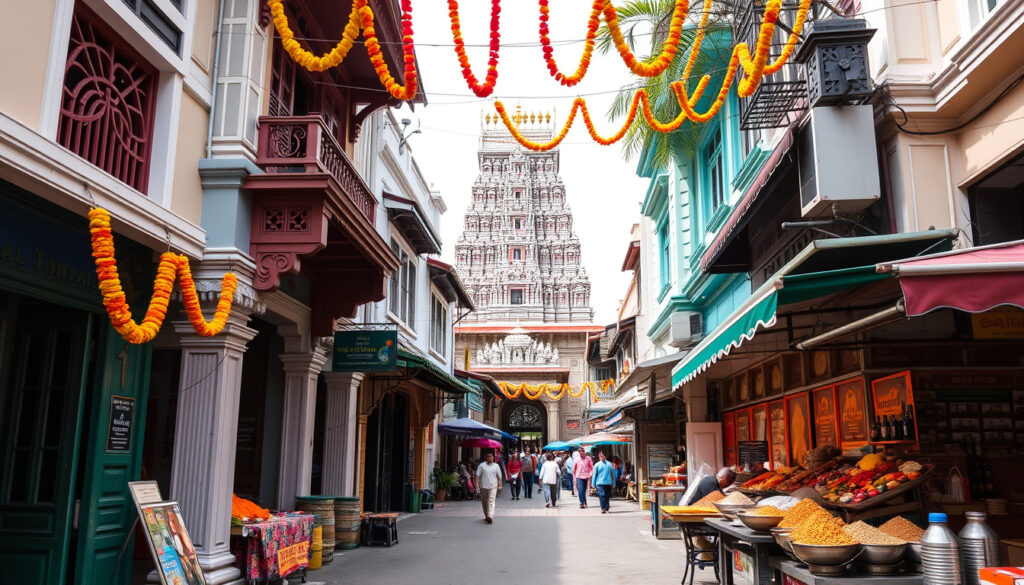
Things to Do in Little India Singapore: A Complete Guide
There’s a moment when you round the corner onto Serangoon Road and the air suddenly smells of jasmine, curry leaves, and incense — that’s when Little India stops being a map marker and becomes a place. The whole district fits inside a documented 2.8 km walking loop (according to Tanken’s Singapore trail database), so nearly everything on the list below is within strolling distance.
Distance from Changi Airport: 20 km ·
Average taxi fare from Changi Airport: SGD 25–35 ·
Walking time for core area: 1–2 hours ·
Best time to visit: 4:00–8:00 PM ·
Distance from Chinatown: 3 km
Quick snapshot
- The documented core loop is 2.8 km with 24 stops, according to Tanken’s trail log
- Tekka Centre, Mustafa Centre, and the main temples all sit inside that core loop (Tanken’s trail log)
- Pace changes the total time: Traveloka’s route note says about 2 hours, while Tanken’s trail log estimates 2h30
- Whether street-art tours run daily is not confirmed on any official listing
- Shop opening hours vary and are not standardized
- The official map’s recommended route starts at the Indian Heritage Centre and moves through Campbell Lane, Serangoon Road, Belilios Road, and Race Course Lane (Roots / National Heritage Board (official trail map))
- Walking estimates for the loop cluster around two hours once you add photo stops (Traveloka (destination guide))
- Most documented routes begin at Little India MRT station (Greg J (self-guided walking-tour notes))
- If you’re planning a second heritage district, Chinatown’s official walking trail is the natural follow-up (Greg J (self-guided walking-tour notes))
Seven facts, one pattern: Little India is compact, cheap to reach, and best treated as a late-afternoon district.
| Fact | Detail |
|---|---|
| Location | Within walking distance of downtown Singapore, near Rochor and Farrer Park MRT |
| Best time | Late afternoon to evening (4 PM – 8 PM) |
| Walking duration | 1–2 hours for main sights |
| Distance from Changi Airport | About 20 km |
| Taxi fare from airport | SGD 25–35 |
| Distance from Chinatown | About 3 km |
| Noteworthy holiday | Deepavali (October/November) — district illuminations and festivities |
Is It Worth Visiting Little India in Singapore?
Little India is worth visiting for one reason that has nothing to do with ticketed attractions: it’s a living heritage enclave rather than a display. The National Heritage Board publishes an official trail map for the district, a designation that turns a working market neighbourhood into a piece of cultural infrastructure (Roots / National Heritage Board (official trail map)). The trade-off is real — hot midday streets, uneven opening hours, no visitor centre — but the things that make it feel chaotic are also the things that make it feel alive.
Pros and cons of visiting Little India
- Pros: streets and markets are the show — flower-garland stalls, spice mountains, goldsmiths, and textile shops along Serangoon Road; temples are free; Mustafa Centre runs 24 hours.
- Cons: the heat makes midday walking draining; some shops close on Tuesday; weekend crowds around Tekka Centre slow everything down.
- Reality check: this is a working district, so expect delivery trucks, loudspeakers, and uneven pavements — that’s not a flaw, it’s the product.
How does Little India compare to Chinatown?
- Chinatown has been organised for visitors: a formal visitor centre, guided tours, and a self-guided trail. Little India has none of that scaffolding.
- Little India’s version of infrastructure is the street itself — the official trail simply walks you through working lanes instead of cordoning them off.
- The two districts sit about 3 km apart, so the practical question is less “which is better” and more “which gets your afternoon”.
If your Singapore itinerary has room for one neighbourhood stop, Little India is the strongest claim on it — because the attraction is the district itself, not a ticket gate.
Which Is Better to Visit in Singapore, Chinatown or Little India?
Both districts deliver the same headline — heritage streets, temples, food, and a fast MRT ride from the city centre. The difference is in the organisation, and the official tourism set-up makes it obvious.
Key differences between Chinatown and Little India
- Chinatown’s official visitor pages divide the district into Kreta Ayer, Tanjong Pagar/Duxton, and Telok Ayer, and base its visitor services at 2 Banda Street, open daily 09:00–18:00 (Chinatown Singapore (district visitor information)).
- Little India has no equivalent visitor centre — the official route is a self-guided map you download and follow at your own pace.
- Chinatown’s visitor setup also includes a free downloadable walking guide from Visit Singapore (national tourism board), so planning support is heavier on that side; Little India keeps the planning load on you.
What to choose based on personal interests
- Choose Little India for South Asian food — biryani, roti prata, banana-leaf rice — plus flower markets and 24-hour shopping at Mustafa Centre.
- Choose Chinatown for traditional Chinese culture, shophouse photography, and a more structured walking experience with visitor support at hand.
- Choose both if you have a full day: at roughly 3 km apart, it’s a quick MRT jump or a long walk between the two, and together they cover most of old Singapore’s ground-floor culture.
What this means: the “better” question has an honest answer — pick Little India for energy and food, pick Chinatown for structure and support.
What Is Little India in Singapore Famous For?
Little India is famous for being the most concentrated South Asian cultural enclave in Singapore — a district where temples, spice shops, flower garlands, and goldsmiths share the same pavements. The official trail treats that daily mixture as the exhibit, and it recommends the Indian Heritage Centre as the starting point for understanding the history of Singapore’s Indian community (Roots / National Heritage Board (heritage trail map)).
Main attractions in Little India
- Sri Veeramakaliamman Temple — the district’s most-visited Hindu temple, dedicated to the goddess Kali.
- Sri Srinivasa Perumal Temple and Sri Vadapathira Kaliamman Temple — the other two major temple stops on the heritage loop.
- Tekka Centre — the hawker and wet market at the district’s southern edge, where queues form for biryani and roti prata.
- Mustafa Centre — a 24-hour department store that functions as a tourist attraction in its own right.
Cultural and historical significance
- The district is an officially designated heritage area, and the National Heritage Board’s trail is itself evidence of that status.
- Festivals are part of the identity: Deepavali (October/November) brings district-wide illuminations, and Thaipusam draws processions through the streets.
- The Indian Heritage Centre anchors the history side, giving the neighbourhood an indoor counterpoint to the open-air market drama.
Famous landmarks
- Serangoon Road — the spine of the district, lined with traditional and modern shops selling clothes, gold, and everyday goods.
- Campbell Lane — the flower-garland corner and the area’s best street photography.
- Race Course Lane — a quieter, more residential strip where the heritage character is easier to see without the crowds.
How Long Does It Take to Walk Around Little India, Singapore?
A relaxed walk covering the main sights takes about 1 to 2 hours, but the honest answer depends on how many times you stop for food, photos, and temple wandering. Most documented routes begin at Little India MRT and cover the core district on foot (Greg J (self-guided walking-tour notes)).
Suggested walking route
- Step 1 — Start at Little India MRT, exit E. The recommended entry point puts you at the southern end of the district.
- Step 2 — Head up Serangoon Road. Pass Sri Veeramakaliamman Temple and the shopfront chaos that defines the main drag.
- Step 3 — Turn into Campbell Lane. Flower garlands, vegetable traders, and the best natural light for photos.
- Step 4 — Detour to Tekka Centre. A short food stop now saves you walking hungry through the rest of the loop.
- Step 5 — Loop back through Belilios Road and Race Course Lane. The residential side of the district, and a calmer finish.
- Step 6 — End at Mustafa Centre. Shop, rehydrate, and take the MRT from Farrer Park.
What you can see in one hour vs two hours
- 1 hour: the Serangoon Road corridor — temple exteriors, a Tekka Centre quick bite, and a Mustafa browse. It’s a corridor visit, not a district visit.
- 2 hours: the full core loop, plus Campbell Lane’s flower market, both main temples, and a proper sit-down meal.
- 3–4 hours: add Sri Srinivasa Perumal Temple, the wet market at Tekka, whatever catches your eye in the spice shops, and unhurried shopping at Mustafa.
The two-hour estimate assumes you keep moving. Add a Tekka Centre meal, a real temple visit, and a Mustafa detour, and the loop quietly becomes half a day — plan for 3–4 hours if you want to experience it rather than photograph it.
What Is the Best Time of Day to Visit Little India in Singapore?
The best window is late afternoon to early evening — roughly 4:00 to 8:00 PM — when the heat drops and the streets fill with the evening crowd that gives Little India its pulse. Mornings work best for temple visits and empty pavements; midday is the weakest slot of the day.
Morning vs afternoon vs evening
- Late afternoon (4–6 PM): the sweet spot — cooler air, fully open stalls, and good side-light on the shophouse facades.
- Evening (6–8 PM): dinner crowds, illuminated signs, and the most atmospheric version of the Mustafa street front.
- Morning (9–11 AM): quieter temples and emptier streets, though many small shops are still setting up.
- Midday (12–3 PM): the worst walking heat and the harshest light — use this block for the Indian Heritage Centre (indoor) instead.
Avoiding the heat and crowds
- Weekdays are noticeably less crowded than weekends, especially around Tekka Centre and Serangoon Road.
- Some shops close on Tuesday, so it’s not the ideal first-visit day.
- Deepavali (October/November) brings huge crowds and district-wide illuminations — book meals early and expect slow movement.
- Carry an umbrella: short late-afternoon downpours are common.
- If the heat wins, retreat to air-conditioned shops and the Indian Heritage Centre; for a completely different green reset, our Jurong Lake Gardens photo guide covers a good second outing.
Arrive at 4 PM and the district hands you a natural itinerary: walk the loop before sunset, eat as the stalls switch to dinner mode, then finish with Mustafa’s 24-hour fluorescent hum.
What this means: the same streets that feel thin at noon turn dense with life after 5 PM. Little India performs best on its own schedule.
Chinatown vs Little India: Side-by-Side
Everything Chinatown formalises, Little India leaves to chance — and both approaches work, just for different travellers.
Six axes, one pattern: infrastructure is the real difference between these two heritage districts.
| Axe | Little India | Chinatown |
|---|---|---|
| Vibe | Loud, colourful, market-driven | Neat heritage quarters with festival décor |
| Walking setup | Self-guided trail; no booking or visitor centre | Guided tours plus a 14-stop self-guided trail (Chinatown Singapore (walking-trail guide)) and a free walking-guide PDF (Visit Singapore national tourism board) |
| Getting there | Little India, Rochor, or Farrer Park MRT | Chinatown/Maxwell is the nearest MRT to the visitor centre (Chinatown Singapore (visitor-centre info)) |
| Food anchor | Tekka Centre hawker stalls, biryani, roti prata | Maxwell Food Centre and traditional Chinese restaurants |
| Retail | Mustafa Centre (24 hours), gold and textile shops | Shophouse boutiques, tea shops, souvenir streets |
| Best for | Sensory wandering, South Asian food, street photography | Structured sightseeing, history plaques, easy visitor access |
Upsides
- Officially recognised heritage district with a free self-guided trail
- Compact 2.8 km loop covers temples, markets, and food
- Temples and street sights are free to enter
- 24-hour shopping at Mustafa Centre anchors the southern end
Downsides
- No visitor centre — you’re self-navigating the whole time
- Midday heat and humidity are physically draining
- Some shops close on Tuesday; opening hours vary by trader
- Weekend crowds slow the pace around Tekka Centre
Confirmed facts
- Little India has an official heritage trail published by Singapore’s National Heritage Board
- Chinatown runs an official visitor centre and a self-guided walking trail
- The late-afternoon window is the most comfortable time to walk the district
What’s unclear
- Route-time estimates differ by guide — around 2 hours by one source, 2h30 by another
- Whether street-art tours run daily is not officially confirmed
- Exact shop hours are not standardised across the district
- Public-holiday crowd levels are hard to predict
Most self-guided Little India routes begin at Little India MRT and cover the core district on foot, which keeps the walk simple even for first-timers.
Greg J (self-guided walking-tour notes)
Chinatown’s official walking guide positions the district around heritage, food, and religious sites, with a visitor facility near Pagoda Street.
Little India is Singapore’s living Indian-heritage district, and the practical verdict is simple: give it a 4 PM start, a two-hour walking loop, and an appetite, and it will outperform most ticketed attractions in the city. The comparison with Chinatown isn’t a contest — it’s a sequence, and Little India’s unpolished energy is exactly what makes it worth doing first. For first-time visitors to Singapore, start at Little India MRT around 4 PM and walk the loop before dark — or accept the hotter, more crowded version of the same streets at midday.
Frequently asked questions
What are the must-try foods in Little India?
Start at Tekka Centre for biryani, roti prata, and Indian sweets, then follow the side streets off Serangoon Road for banana-leaf rice and South Indian coffee. A hawker meal here is one of the cheapest proper dinners in Singapore.
Is Little India safe to visit at night?
Yes, in the practical sense: the main streets stay busy into the evening, especially around Mustafa Centre and Tekka Centre. Stick to the well-lit main roads and use normal city-night awareness, and Little India is no riskier than the rest of central Singapore.
Can you visit Little India on a budget?
Easily. Temples and street sights are free, the heritage trail costs nothing to follow, and hawker meals at Tekka Centre are inexpensive. Mustafa Centre is the default spot for budget souvenirs and 24-hour essentials.
What are the opening hours of Sri Veeramakaliamman Temple?
The temple typically opens early morning and closes in the evening, but hours shift during festivals and special observances. Check the temple’s current schedule before you go, and dress modestly.
Are there guided walking tours in Little India?
The main heritage route is self-guided and free, so no booking is needed for the loop. For guided options, the Indian Heritage Centre is the right place to ask about current tours; the official trail map serves as the de facto guide.
How do I get from Little India to Singapore Zoo?
The zoo is outside the city centre, so take a taxi or ride-hail directly from Little India, or combine the MRT with a shuttle to Mandai. This is not a walking or short-hop trip — plan around half a day for the transfer plus the zoo visit.
What is the best way to get around Little India?
On foot. The core loop is only 2.8 km, so walking is the only sensible way to see the district. Use Little India, Rochor, or Farrer Park MRT as entry and exit points, with Mustafa Centre as a useful air-conditioned escape.
More related posts
 Al-Nassr Standings 2025-26: Saudi Pro League Position & AFC
 UOB Gold and Silver Price Today – Live Rates & Analysis
 Hawker Centre Cleaning 2025: Complete Schedule & Essential Guide
 Singapore to Jeju Direct Flight: Time, Price & Schedule
 สล็อต VIP pglucky88.blog – Verified Facts on Luck88 VIP Slot
 White Lotus Season 3: Episodes, Schedule, Controversy
 4 by 2 Haircut SAF: What It Is and How to Get It for NSmen
 Bokep Viral Teh Pucuk – Hoax Facts, Phishing Risks