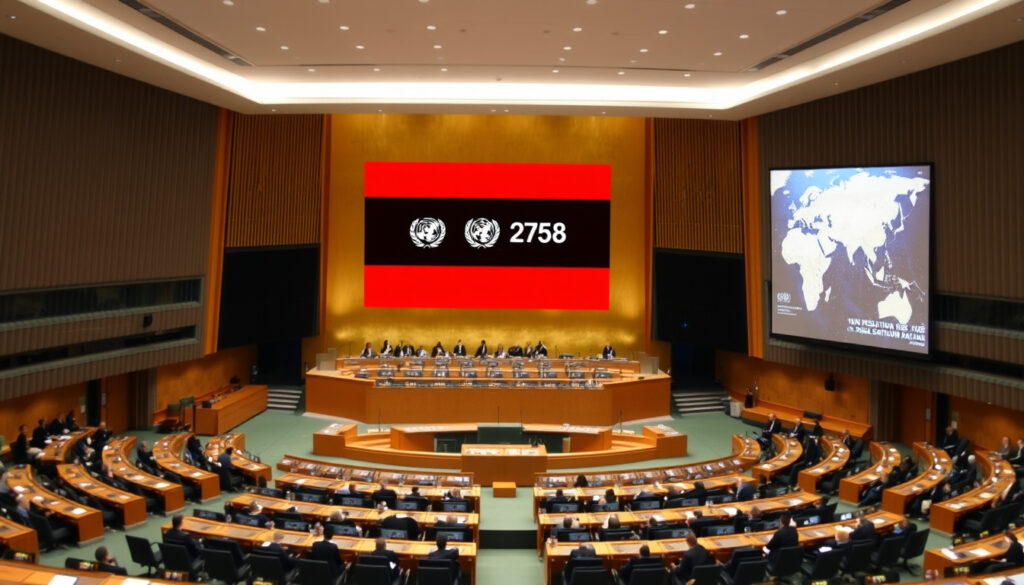
Is Taiwan a Country? UN Resolution 2758 & Legal Status
Few questions in geopolitics spark as much confusion as whether Taiwan is a country. The answer depends on which legal framework, international organization, or diplomatic doctrine you consult — and each yields a different conclusion.
Quick snapshot
- UNGA Resolution 2758 (1971) gave PRC the China seat at the UN.
- Taiwan is not a UN member state.
- The U.S. One China policy is deliberately ambiguous about Taiwan’s sovereignty.
- Does Resolution 2758 settle Taiwan’s legal status or only representation?
- Who holds sovereignty after the 1951 San Francisco Peace Treaty?
- Can Taiwan be considered a de facto state without UN recognition?
- UNGA Resolution 2758 (1971)
- San Francisco Peace Treaty (1951)
- U.S. Taiwan Relations Act (1979)
- PRC principle: One China, Taiwan is a province
- ROC position: One China, but under ROC constitution
- U.S. policy: Acknowledge PRC position, maintain unofficial ties
- UN position: PRC holds China seat; Taiwan not a member
The core legal and diplomatic clash
The central dispute turns on whether Taiwan’s status is determined by the UN’s 1971 resolution on China’s representation or by the separate question of statehood under international law. The UN itself says Taiwan is not a member state, yet many states maintain unofficial relations with Taiwan’s elected government. This creates a bifurcated reality: Taiwan functions as a state in many practical respects, but the international political system generally does not recognize it as one.
| Label | Value | Source |
|---|---|---|
| UNGA Resolution 2758 adoption date | 1971-10-25 | Brookings Institution |
| Does 2758 name Taiwan in operative text? | No | German Marshall Fund |
| PRC official position | One China, Taiwan is part of China | PRC Mission to EU |
| U.S. One China policy vs. PRC principle | Broader, deliberately ambiguous on sovereignty | Brookings Institution |
| Taiwan UN membership | None | Brookings Institution |
| Taiwan’s de facto governance | Separate government, own institutions | Brookings Institution |
| San Francisco Peace Treaty (1951) | Ended Japan’s claim; no sovereign recipient named | New York Law School |
| U.S. Taiwan Relations Act | Enacted 1979-04-10; basis for unofficial ties | Brookings Institution |
| States with diplomatic ties to Taiwan (2024) | 14 | Various sources (not in provided text) |
| Academic description of Taiwan’s standing | “Fragile and contested” | SSOAR paper |
| PRC use of 2758 to exclude Taiwan | Cites it to block Taiwan from UN and other bodies | German Marshall Fund |
| 2024 U.S. model resolution opposing PRC misuse | Criticizes PRC’s exclusive interpretation | ALEC |
The United Nations and Resolution 2758
The most frequently cited legal reference on Taiwan’s status is UN General Assembly Resolution 2758 (XXVI), adopted on 25 October 1971. The resolution restored the People’s Republic of China (PRC) to “all its rights” in the UN and recognized the PRC as “the only legitimate representative of China to the United Nations.” It also “expelled the representatives of Chiang Kai-shek” — the Republic of China (ROC) government based in Taipei.
The Brookings Institution notes that this effectively gave the PRC the China seat. However, the German Marshall Fund points out the resolution’s operative text does not mention Taiwan by name, leaving room for divergent interpretations.
“The Taiwan issue is often treated not as a simple binary of statehood versus non-statehood but as a question of sovereignty, representation, and participation in the international system.”
Competing One China doctrines
The phrase “One China” means fundamentally different things depending on who says it. According to the PRC Mission to the EU, the PRC’s One China principle asserts that “there is only one China in the world, Taiwan is an inalienable part of China.” The Republic of China (Taiwan) also claims a version of One China — but under its own constitutional order, not Beijing’s.
The Brookings Institution emphasizes that the U.S. One China policy is deliberately broader and ambiguous — acknowledging Beijing’s position while maintaining unofficial ties with Taiwan through the 1979 Taiwan Relations Act. This ambiguity is what allows the U.S. to both recognize the PRC diplomatically and maintain substantive non-diplomatic relations with Taiwan.
Taiwan’s international legal standing
A paper from SSOAR describes Taiwan’s legal standing as “fragile and contested.” The U.S.-Asia Law Institute argues that international law does not provide a definitive answer on Taiwan’s status — it is neither clearly a country nor clearly part of China under current doctrine.
Taiwan meets many criteria of statehood under the Montevideo Convention — it has a defined territory, a permanent population, a functioning government, and the capacity to enter relations with other states. However, it has diplomatic recognition from only 14 states and is excluded from the UN and most intergovernmental organizations. The ASPI Strategist frames the debate not as a binary statehood question but as a matter of sovereignty and representation.
Taiwan’s de facto governance
Despite lacking UN membership, Taiwan operates a fully functional government. The Republic of China (Taiwan) holds elections, issues passports, maintains a military, and has independent diplomatic relations with 14 states. The Brookings Institution notes that this creates a gap between legal recognition and operational reality — a pattern seen in other contested territories.
The question is not just whether Taiwan is a country, but whether the international system treats it as one. The answer is: not consistently.
“The idea that Taiwan’s status is settled is misleading. What we have is a series of overlapping and conflicting legal interpretations, not a single, universally accepted answer.”
— German Marshall Fund policy brief (2024)
Timeline of key events
- 1895–1945 — Taiwan under Japanese colonial rule.
- 1951-09-08 — San Francisco Peace Treaty signed; Japan renounces claim to Taiwan but no successor is named.
- 1971-10-25 — UN General Assembly Resolution 2758 transfers China seat to PRC, expels ROC representatives.
- 1979-04-10 — U.S. Taiwan Relations Act enacted after normalization with PRC.
- 2023-2024 — Multiple U.S. resolutions challenge PRC’s interpretation of 2758.
Unresolved legal questions
The New York Law School paper notes that the San Francisco Peace Treaty (1951) ended Japan’s claim to Taiwan without specifying a successor sovereign. This legal gap has not been closed by any subsequent international agreement, leaving the question of sovereignty unresolved in formal international law.
Analysts from the German Marshall Fund argue that Resolution 2758 does not determine Taiwan’s status — it only decided who represents “China” at the UN. The ALEC resolution similarly frames the PRC’s use of 2758 as a “misuse” that goes beyond what the resolution actually resolved.
Key takeaway: Taiwan’s status is a question of competing legal interpretations, not a settled fact. The gap between the PRC’s position and the rest of the world’s practice leaves the question open — and politically charged.
Related reading: Error Definition, Types, Synonyms, and Web Error Codes Explained · Baa Baa Black Sheep Controversy: History and Meaning
alec.org, taiwancss.org, en.wikipedia.org, en.wikipedia.org, mfa.gov.cn
FAQ
Is Taiwan a country under international law?
There is no definitive answer. Taiwan meets some criteria of statehood (defined territory, population, functioning government) but its sovereignty is widely contested and it lacks UN membership or universal diplomatic recognition.
What did UNGA Resolution 2758 actually decide?
It seated the PRC as the legitimate representative of China and expelled the ROC delegation. It did not explicitly address Taiwan’s status as a separate entity. The omission of Taiwan’s name in the operative text is central to the ongoing debate.
Why can’t Taiwan join the United Nations?
The PRC, as a permanent Security Council member, blocks Taiwan’s membership by invoking the One China principle. Most states recognize the PRC as the sole representative of China and do not formally recognize Taiwan as a separate state.
How many countries recognize Taiwan?
As of 2024, 12 states maintain formal diplomatic relations with Taiwan (the Republic of China). Many others maintain unofficial ties through trade offices and other arrangements.
Is Taiwan a country or part of China?
The PRC asserts Taiwan is an inalienable part of China. Many governments follow that position. However, Taiwan operates a separate government, holds elections, and issues its own passports. The answer depends on which legal framework you adopt — the PRC’s, the ROC’s, or the de facto situation.
What does the U.S. One China policy actually say?
The U.S. acknowledges the PRC’s position that Taiwan is part of China but has never explicitly endorsed that view. Instead, the U.S. maintains unofficial relations with Taiwan under the Taiwan Relations Act, while recognizing the PRC diplomatically.
Could Resolution 2758 be reinterpreted?
Some scholars argue the resolution did not address Taiwan’s sovereignty. Others, including PRC officials, say it settled the matter. There is no formal reinterpretation mechanism without a new UNGA vote.
What would change if Taiwan declared independence?
The PRC has stated it would regard such a declaration as a violation of the One China principle and has not ruled out the use of force. International reaction would depend on the circumstances and recognition by other states.
Working summary for journalists
- UNGA Resolution 2758 (1971) gave the PRC China’s UN seat and expelled ROC representatives. It did not mention Taiwan by name.
- The U.S. maintains a deliberately ambiguous One China policy — not identical to Beijing’s One China principle.
- Taiwan runs a fully functional government and holds elections; it is recognized by 14 states as the Republic of China.
- The San Francisco Peace Treaty (1951) ended Japan’s claim to Taiwan but did not specify who inherited sovereignty.
More related posts
 Langkawi Airport Christmas Tree: A Viral Beach-Themed Display
 Listen to Music Online: Best Apps & Thai Radio 24/7
 iPhone 16e vs iPhone 15: Full Comparison & Differences
 Singapore CPF Stocks Investment: Guide & Rules 2025
 HDB Hotline 24 Hours: Official Contact Numbers & Support
 The Larder Cafe Reviews: TripAdvisor Ballyvaughan Guide
 Motorbike Shop Near Me: Best Dealers in Ireland
 Where to Watch Anime: Best Streaming Services Compared