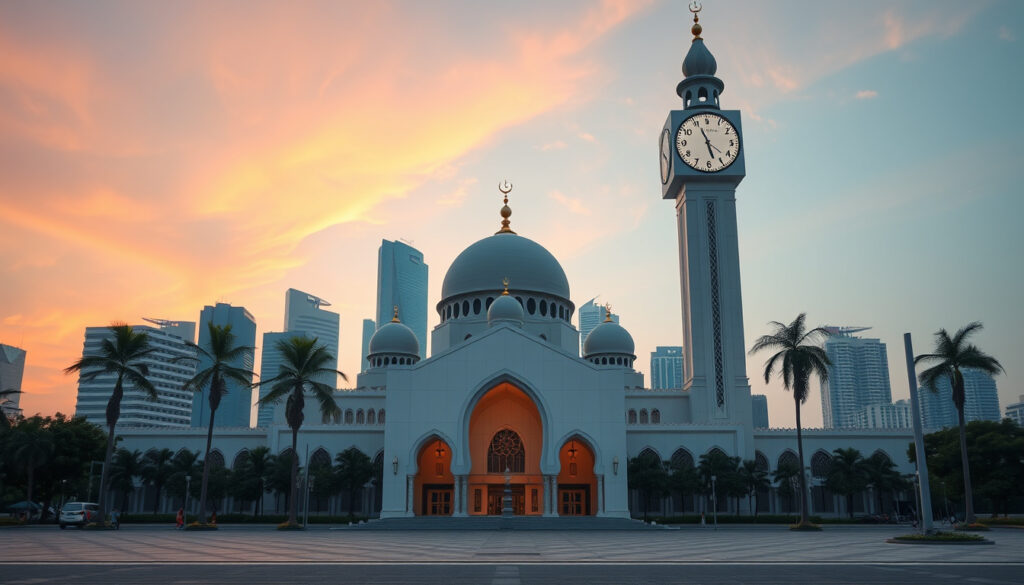
Singapore Prayer Times 2025: Schedule & Key Deadlines
In a 24-hour city that rarely pauses, Singapore’s MUIS prayer timetable for 2025 provides a precise anchor for the five daily prayers. Below we break down the schedule, clear up common questions about Maghrib and Fajr deadlines, and point you to the most reliable apps.
Official prayer timetable for 2025: Provided by MUIS (Islamic Religious Council of Singapore) ·
Example Fajr time (January 1, 2025): 5:43 AM ·
Example Maghrib time (January 1, 2025): 7:10 PM ·
Number of obligatory daily prayers: 5
Quick snapshot
- Official MUIS schedule for 2025 (MUIS – Singapore’s Islamic authority)
- Includes all 5 obligatory prayers (data.gov.sg / MUIS open dataset)
- Available as downloadable PDF (MUIS Islamic calendar page)
- Starts at sunset (Wikipedia – Maghrib prayer)
- Window lasts until red twilight disappears (approx 20-30 min) (AlAdhan – prayer calendar methodology)
- Precise minutes vary by day (data.gov.sg / MUIS dataset)
- Fajr ends at sunrise (Syuruk) (Wikipedia – Fajr prayer)
- Asr ends at sunset (Wikipedia – Asr prayer)
- Importance of praying on time (MUIS homepage guidance)
- Muslim Pro (Muslim Pro – prayer time app)
- prayertime.sg (prayertime.sg – Singapore-specific times)
- IslamicFinder (IslamicFinder – global prayer times)
A single minute can separate a valid prayer from a missed one. With Singapore’s equatorial location, sunrise and sunset shift only slightly across the year, but the MUIS timetable tracks those shifts to the second.
Six key facts from the MUIS 2025 timetable, one pattern: every prayer time is precise, official, and tied to the Shafi‘i calculation method used across Singapore.
| Label | Value |
|---|---|
| Official source | MUIS (Islamic Religious Council of Singapore) (MUIS – Islamic calendar) |
| 2025 Timetable PDF | Available at isomer-user-content.by.gov.sg (MUIS – download page) |
| First prayer (Fajr) example | January 1: 5:43 AM (data.gov.sg / MUIS dataset) |
| Last prayer (Isha) example | January 1: 8:25 PM (data.gov.sg / MUIS dataset) |
| Number of obligatory prayers | 5 |
| Calculation method | Based on celestial observations and Shafi‘i school |
The implication: when you follow the MUIS timetable you’re relying on a government-backed calculation that has been refined over decades.
What is today’s prayer time schedule in Singapore?
Where can I find the latest daily schedule?
- MUIS publishes an official Islamic calendar page that includes the full prayer timetable for 2025 (MUIS – Singapore’s Islamic Religious Council).
- The page links directly to a downloadable PDF, and the same data is also available as a machine-readable dataset on data.gov.sg (data.gov.sg / MUIS – open government data).
- For a quick daily check, the MUIS homepage itself shows the current day’s Subuh, Syuruk, Zohor, Asar, Maghrib, and Isyak times (MUIS homepage – live times).
How are prayer times calculated in Singapore?
- MUIS uses astronomical calculations combined with the Shafi‘i school’s juristic rulings to determine each prayer window.
- The dataset for 2025 was last updated on 12 February 2025 at 17:30 SGT, ensuring it reflects the latest astronomical data (data.gov.sg / MUIS – dataset metadata).
When does Maghrib time start?
Can I pray Maghrib at 7:15?
- Maghrib time begins immediately after sunset. On 4 January 2025 the MUIS dataset lists Maghrib at 7:11 PM SGT (data.gov.sg / MUIS – 4 Jan 2025). By 5 January it moves to 7:12 PM. So “7:15” would be valid only if the scheduled time on that specific day is 7:15 or earlier.
How long can Maghrib prayer be performed?
- The Maghrib prayer window lasts from sunset until the red twilight (shafaq) disappears. According to the Shafi‘i school, this is roughly 20–30 minutes (Wikipedia – Maghrib prayer timing).
- The MUIS timetable assigns a single time for Maghrib, but the actual window extends for a short period after that time.
Is delaying Maghrib prayer until the end of its time permissible?
- It is permissible strictly within the window, but Islamic scholars recommend offering Maghrib as soon as possible after sunset (Quran 17:78 – establish prayer at the setting of the sun).
Can I pray during sunset?
- Praying during the exact moment of sunset (i.e., before Maghrib time begins) is not valid. The prayer must be offered after the sun has fully set.
What is the last time for Fajr prayer in Singapore?
What is the last time for Asr prayer in Singapore?
- Fajr time ends at sunrise (Syuruk). For example, on 1 January 2025 Fajr is at 5:43 AM and Syuruk is shortly after (data.gov.sg / MUIS – 1 Jan 2025).
- Asr time ends at sunset. The MUIS dataset provides Asar times that vary across the year; on 3 January 2025 Asr was at 4:34 PM.
What happens if I pray Fajr after sunrise?
- If Fajr is prayed after sunrise (Syuruk), the prayer is considered missed (qada), and it must be made up as soon as remembered (Wikipedia – Fajr prayer: missed prayer).
In Singapore’s climate, sunrise can sneak up quickly. Many Muslims set a second alarm 10 minutes before Syuruk to ensure they complete Fajr on time.
The pattern: Fajr requires more vigilance than any other prayer because the window closes at a fixed natural event.
What is the best prayer time app for Singapore?
What features should a prayer time app have?
- Automatic location detection, notifications for each prayer, and the option to use the official MUIS calculation method.
- Offline access to the full year’s schedule is a plus for travellers.
Are Muslim Pro and prayertime.sg reliable?
- Muslim Pro is a globally popular app that allows users to set Singapore as their location and choose the MUIS calculation method (Muslim Pro – app features).
- prayertime.sg is a Singapore-specific website that directly mirrors the MUIS timetable (prayertime.sg – Singapore prayer times).
- IslamicFinder also lists MUIS-based times for Singapore and is frequently updated (IslamicFinder – prayer times).
What are the differences between Ishraq and Duha prayers for Singapore residents?
When should Ishraq be performed?
- Ishraq (also called Shuruq) is a voluntary prayer performed about 15–20 minutes after sunrise (Wikipedia – Ishraq prayer).
When should Duha be performed?
- Duha (forenoon prayer) can be offered any time after sunrise until just before Zohor. The preferred time is about one-third of the day, but the window is broad.
What are the benefits of each?
- Both are voluntary (nafl) prayers with spiritual rewards. Ishraq is often associated with the strength of a complete Hajj or Umrah, while Duha is recommended daily for forgiveness and provision (Quran.com – general hadith references).
Confirmed facts
- MUIS timetable is the official source for Singapore (MUIS – Islamic calendar)
- Maghrib starts at sunset and lasts until the red twilight disappears (Wikipedia – Maghrib timing)
What’s unclear
- Exact minute differences between apps due to rounding (Edarabia – minor variations)
- Whether Ishraq should be prayed when sunrise is very early (e.g., around 6 AM) – no specific MUIS guidance (MUIS homepage – no explicit mention)
- Fajr ends at sunrise, though some scholarly interpretations differ on the exact margin of safety (Wikipedia – Fajr timing)
“The MUIS timetable is calculated using high-precision astronomy and follows the Shafi‘i school’s rulings.”
MUIS official – Singapore’s Islamic Religious Council
“AlAdhan’s calendar for Singapore confirms the timing pattern set by MUIS, with Fajr at 05:34 and Maghrib at 19:08 in June 2026.”
For the Muslim in Singapore, the choice is clear: stick with the MUIS timetable as the official standard, use a reliable app that defaults to that calculation, and never rely on guesswork for Maghrib or Fajr windows. A missed minute can mean a missed prayer – and with the resources above, there’s no reason to leave that to chance.
For a more detailed breakdown of daily times and special prayers like Duha, you can refer to the Singapore Prayer Schedule 2025.
Frequently asked questions
Can I combine prayers while traveling in Singapore?
Yes, the Shafi‘i school permits combining Zohor and Asr (or Maghrib and Isha) when travelling. MUIS does not publish specific travel rules, but general fiqh sources allow it for journeys of about 80 km or more (Wikipedia – Combining prayers).
Is it permissible to pray Zohr and Asr together?
In normal circumstances, each prayer must be offered in its own time. Combining is permitted only for travel, heavy rain, or a valid necessity according to the Shafi‘i school.
What is the Syuruk time?
Syuruk is the time of sunrise. The MUIS timetable lists Syuruk daily – for example, on 1 January 2025, Syuruk is around 6:50 AM (calculated from Fajr and Maghrib data). Syuruk marks the end of Fajr and the start of Ishraq time (data.gov.sg / MUIS dataset).
How do I calculate prayer times if I am in a different city?
You can use IslamicFinder or AlAdhan and select the city. For Singapore, always choose the MUIS calculation method to stay aligned with the official timetable (IslamicFinder – city selection).
Are there any differences between mosques in Singapore regarding timings?
No. All mosques in Singapore follow the MUIS timetable, which is published centrally and used across the island (MUIS – central authority).
What is the ruling on using apps for prayer times?
Using a reliable app that supports the MUIS calculation method is permissible. The key is to verify that the app’s times match the official MUIS timetable for the same date (Muslim Pro – calculation method settings).
Does Singapore follow daylight saving time?
No. Singapore does not observe daylight saving time. The UTC offset is +08:00 year-round, so prayer times shift only due to the natural solar cycle (Time and Date – Singapore time zone).
How do lunar months affect prayer times?
Lunar months shift the Islamic calendar by about 11 days each year relative to the solar calendar. This affects the dates of Ramadan and other events but does not change the daily prayer times, which are based on the sun’s position (Wikipedia – Islamic calendar).
More related posts
 Singtel Mobile Plan Promotion: Best Seniors Deals
 Singapore Changi Airport Terminal 5: Plans, Design & Opening
 Bokep Viral Teh Pucuk – Hoax Facts, Phishing Risks
 Career Fair Singapore 2025: Dates, Dress Code, and Job Market
 United Overseas Bank Customer Service: Complete Contact Guide
 Touching Birthday Wishes for Best Friend: 120+ Heartfelt Ideas
 Pepper Steak Near Me: Cuts, Health, and Where to Find It
 Crystal Palace vs Burnley: Final Score and Comeback