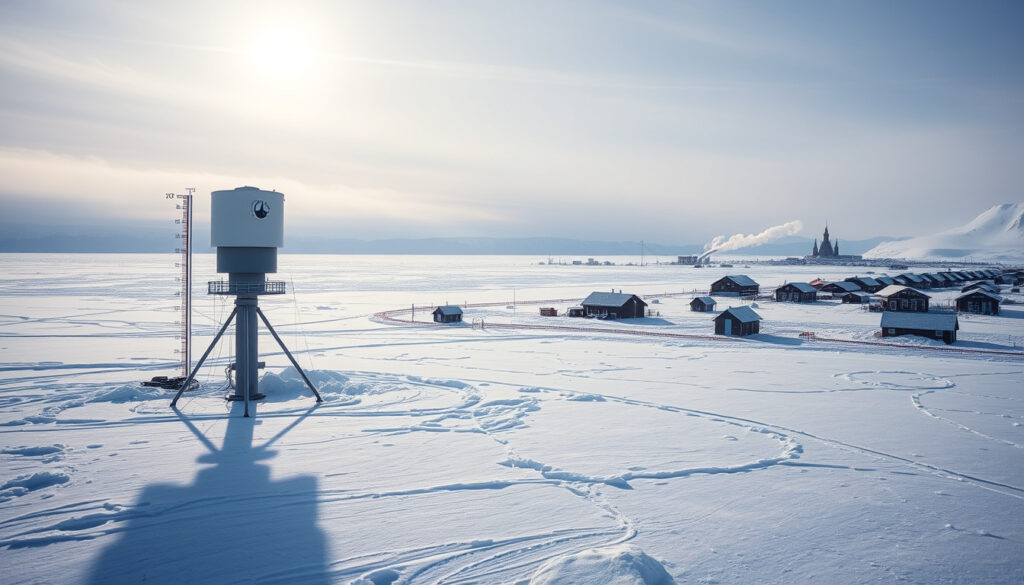
Coldest Place on Earth: Antarctica’s Records and Siberia’s Towns
You probably know Antarctica is the coldest place on Earth — but did you know that the coldest inhabited places are actually in Siberia? This distinction between absolute record and human habitation is sharper than most realize, and here’s what the records show, how humans manage to live through extreme cold, and why Antarctica remains a world apart.
Coldest recorded temperature: −89.2°C (−128.6°F) ·
Coldest inhabited place: Oymyakon, Russia (≈ −50°C winter average) ·
Coldest continent: Antarctica ·
Coldest permanently inhabited city: Yakutsk, Russia (−8.8°C annual mean) ·
Lowest satellite-measured surface temperature: −93°C (−135°F) in East Antarctica
Quick snapshot
- −89.2°C at Vostok Station, Antarctica, 1983 (Australian Antarctic Program (government research agency))
- Satellite saw −93°C on East Antarctic plateau (NASA Scientific Visualization Studio (U.S. space agency))
- Oymyakon, Russia (winter avg −50°C) (Live Science (science news outlet))
- Yakutsk, Russia (annual mean −8.8°C) (Live Science (science news outlet))
- Verkhoyansk, Russia (record −67.8°C) (NASA Scientific Visualization Studio)
- Antarctica is colder overall (higher elevation, ice sheet) (Australian Antarctic Program)
- Siberia has seasonal extremes – very cold winters, hot summers (Australian Antarctic Program)
- Only Antarctica has no permanent human population (Live Science)
- Yakutsk residents use multi-layer clothing, heated buildings (BBC News (global news service))
- Arctic supports human life; Antarctica only supports temporary scientific stations (BBC News (global news service))
- Over 370,000 people live in Yakutsk despite extreme cold (BBC News (global news service))
The table below summarizes the key records and locations.
| Attribute | Value |
|---|---|
| Coldest temperature ever recorded (ground) | −89.2°C (−128.6°F) |
| Location of record | Vostok Station, Antarctica |
| Date of record | 21 July 1983 |
| Coldest inhabited place (by winter average) | Oymyakon, Russia (≈ −50°C) |
| Coldest city (annual mean) | Yakutsk, Russia (−8.8°C) |
| Coldest continent | Antarctica |
What is the coldest place on Earth?
The simple answer is Antarctica, specifically the high plateau of East Antarctica. The lowest natural ground temperature ever measured was −89.2°C (−128.6°F) at Vostok Station on 21 July 1983, a record verified by the Australian Antarctic Program (national polar research agency) and confirmed by the World Meteorological Organization (global authority on weather records). Satellite measurements have since detected even lower surface temperatures — as low as −93°C (−135°F) on the East Antarctic Plateau during clear winter nights, according to NASA (U.S. space agency).
Which continent holds the record for lowest temperature?
- Antarctica holds the official record at −89.2°C. The IceCube Neutrino Observatory (Antarctic research station) operated by the University of Wisconsin–Madison notes that even the South Pole itself has recorded −82.8°C.
- The Independent (UK news media) described the East Antarctic Plateau as the title-holder for the coldest place on Earth.
How is the coldest place measured – ground versus satellite?
- Ground stations like Vostok measure air temperature 2 meters above the surface. Satellites use infrared sensors to detect surface skin temperature, which can be colder than the near-surface air.
- NASA’s satellite data in the 2000s revealed the −93°C reading — a value that has not been officially verified as a ground-level air temperature record, but shows the extremes of the ice surface.
What are the top 10 coldest places on Earth?
A ranking based on recorded low temperatures includes:
- 1. Vostok Station, Antarctica (−89.2°C)
- 2. Dome Argus, East Antarctica (−82.5°C estimated)
- 3. South Pole (−82.8°C per IceCube)
- 4. Oymyakon, Siberia (−71.2°C per BBC News (international broadcaster))
- 5. Verkhoyansk, Siberia (−67.8°C per NASA)
- 6. Yakutsk, Siberia (−64.4°C per BBC Science Focus (popular science magazine))
- 7. Mount McKinley summit, Alaska (−60°C)
- 8. Klinck Research Station, Greenland (−58°C)
- 9. Snag, Yukon (−63°C, Canada’s record)
- 10. Prospect Creek, Alaska (−62°C)
Antarctica owns the absolute cold records, but Siberia’s inhabited settlements regularly experience temperatures that rival the continent — and they do so with people living there year-round.
The pattern is clear: Antarctica holds the absolute cold records, but Siberia is home to the people who endure extreme cold.
Which is colder, Siberia or Antarctica?
Antarctica is colder on every metric. The reason is elevation and ice. Antarctica’s interior sits above 3,000 meters, under a permanent ice sheet that reflects sunlight and traps cold air. Siberia’s lowlands and seasonal snowpack make it less extreme overall, but its inhabited villages still face winter averages below −45°C.
Four key comparisons, one pattern: Antarctica dominates the extremes, while Siberia dominates the “coldest where people live” category.
| Metric | Antarctica | Siberia |
|---|---|---|
| Lowest recorded temperature | −89.2°C (Vostok Station) | −67.8°C (Verkhoyansk) / −71.2°C (Oymyakon) |
| Average winter temperature (interior) | −60°C | −40°C to −50°C |
| Highest elevation | 4,093 m (Dome Argus) | ~500 m (Siberian lowlands) |
| Permanent human population | None (only temporary research stations) | Yes — towns and cities with over 370,000 people in Yakutsk alone |
Why is Antarctica colder than Siberia?
- Antarctica’s high elevation and persistent ice sheet make it colder. The Australian Antarctic Program explains that the ice sheet creates a stable, cold air mass that deepens in winter.
- Siberia lacks a permanent ice cap and experiences strong seasonal variation due to continental climate.
What are the mean temperatures of each region?
- Antarctica’s interior averages around −60°C in winter; coastal stations average −20°C to −30°C.
- Siberian towns like Oymyakon average about −50°C in winter, per BBC News.
Do any inhabited places in Siberia reach Antarctic-level cold?
- The lowest ground temperature in Siberia is about −71.2°C (Oymyakon), still 18°C warmer than Vostok’s record.
- However, the Svalbard islands (Norway) and parts of Greenland can approach Antarctic cold, but they have far smaller populations.
Siberia’s cold is brutal enough for frostbite in minutes, yet it supports permanent villages. Antarctica’s cold is so extreme that even short exposure without professional gear is lethal.
The implication: Antarctica’s cold is so severe that it prevents permanent human settlement, while Siberia’s cold, though extreme, is survivable with adaptation.
Can people survive in Yakutsk?
Yes — more than 370,000 people call Yakutsk home, despite winter lows that regularly drop below −40°C and a record low of −64.4°C measured in 1891 (BBC Science Focus). The annual mean temperature is −8.8°C, making it the coldest city on Earth with a population over 200,000.
What is the climate like in Yakutsk throughout the year?
- Winter (November–March): temperatures frequently below −40°C, with extreme bouts near −60°C.
- Spring and autumn are brief and chilly, often still below freezing.
- Summer (June–August): surprisingly warm, with July averages around +19°C and occasional peaks above +30°C — one of the most dramatic seasonal swings of any city.
How do residents cope with extreme cold?
- Residents wear multiple layers, fur hats, and fur-lined boots. Cars are kept in heated garages or left running for hours.
- Buildings are built on permafrost piles to prevent sinking, and indoor plumbing is heavily insulated.
- The city has a thriving economy based on diamond mining and power generation.
Climate change is thawing the permafrost beneath Yakutsk, threatening infrastructure and increasing maintenance costs — a long-term risk for residents.
The catch: Yakutsk’s extreme seasonality and permafrost thaw pose long-term challenges despite its inhabitants’ remarkable adaptation.
Is Yakutsk ever warm during summer?
- Yes — summer highs can reach the mid-20s°C, and occasionally exceed +30°C. The temperature swing from winter low to summer high can be more than 80°C.
- This extreme seasonality is a hallmark of the Siberian continental climate.
Why is Antarctica highly guarded?
“Guarded” in the context of Antarctica means protected under international law, not militarized. The Antarctic Treaty of 1959 sets aside the entire continent for peaceful scientific research and bans all military activity, nuclear tests, and waste disposal.
What is the Antarctic Treaty?
- Signed in 1959 by 12 nations, now with 56 parties, it designates Antarctica as a natural reserve devoted to peace and science.
- The Antarctic Treaty Secretariat (international body governing the treaty) confirms that any national presence is strictly regulated and non-military.
Why is military activity banned on the continent?
- The treaty was created during the Cold War to prevent territorial conflict and ensure freedom for scientific research.
- No country may claim new territory, and existing claims are frozen.
How does guarding differ from militarization?
- Guarding refers to environmental oversight: permits for visits, waste management, and protection of unique ecosystems.
- Militarization is expressly forbidden — no armed forces, bases, or weapons testing are allowed.
What this means: Antarctica’s “guarding” is environmental stewardship, not military defense, ensuring the continent remains a natural reserve for science.
What is buried under the ice in Antarctica?
Beneath the Antarctic ice sheet, which averages 2 km thick, lie hidden landscapes: mountains, valleys, and more than 400 subglacial lakes. The largest known is Lake Vostok, buried under nearly 4 km of ice.
Are there ancient lakes under the ice?
- Yes — Lake Vostok is a freshwater lake about the size of Lake Ontario that has been sealed for millions of years.
- Russian and American scientists have drilled into it, recovering water samples that contain microbial life adapted to extreme pressure, darkness, and cold.
What have scientists discovered beneath the ice sheet?
- Core samples from the ice above Vostok provide a continuous climate record going back 400,000 years (Australian Antarctic Program).
- No human-made structures or “buried cities” exist — the only objects are natural formations.
What is the Vostok subglacial lake?
- It is the largest of the subglacial lakes, roughly 250 km long and 50 km wide.
- The water is kept liquid by geothermal heat and the immense pressure of the ice above.
Lake Vostok and its brethren are the closest analog we have to icy moons like Europa and Enceladus — if life survives under Antarctic ice, it could survive on other worlds.
The significance: Subglacial lakes like Vostok are windows into Earth’s climate history and potential analogs for extraterrestrial life.
What experts say about life in the cold
“It’s a place where there’s a very shallow layer of air that is extremely cold because it’s isolated from the main atmosphere.”
— Ted Scambos, senior research scientist at the National Snow and Ice Data Center (NSIDC), on the East Antarctic plateau’s record lows
“The villages of Oymyakon and Verkhoyansk in northeastern Siberia are considered the coldest permanently inhabited places on Earth.”
— NASA Earth Observatory (earth science education program)
“The Treaty ensures that Antarctica is used for peaceful purposes only and prohibits any measures of a military nature.”
The cold extremes of Earth teach us about survival, climate history, and the limits of life. For anyone fascinated by the planet’s harshest environments, the distinction between Antarctica’s uninhabitable cold and Siberia’s resilient communities is the key takeaway. For travelers and climate researchers alike, the choice is clear: visit Yakutsk for an authentic cold-weather experience, or admire Antarctica’s ultimate cold from afar — via the data that scientists continue to gather.
thenationalnews.com, livescience.com, mentalfloss.com, firstpost.com
Frequently asked questions
How cold does Yakutsk get in winter?
Winter lows frequently drop below −40°C, with the record low at −64.4°C.
What is the coldest temperature ever recorded in Siberia?
The official record is −67.8°C in Verkhoyansk (1892) and −71.2°C in Oymyakon (unofficial). NASA cites both locations.
Are there any animals that live in Antarctica?
No terrestrial mammals live on the continent. Only seabirds (penguins, petrels) and marine mammals (seals, whales) visit the coast.
Why is Antarctica colder than the Arctic?
Antarctica is a high-elevation continent covered by ice; the Arctic is a frozen ocean surrounded by land that cannot reach as extreme cold because sea ice is thinner and the ocean moderates temperature.
Can you drink water from melted Antarctic ice?
Yes — the ice is very pure, though it may contain trace elements and microbes. Research stations melt it for drinking after treatment.
Do people live in Antarctica year-round?
No permanent residents. Around 1,000–5,000 scientists and support staff stay at research stations seasonally; about 1,000 overwinter.
How do scientists stay warm in Antarctica?
They wear extreme cold-weather gear (down suits, vapor barrier boots), live in heated buildings, and limit outdoor exposure.
Has it ever snowed in the Sahara desert?
Yes, very rarely — most recently in January 2022 in Algeria. The Sahara’s average winter temperature is around 10–15°C, not cold enough for persistent snow.
More related posts
 Error Definition, Types, Synonyms, and Web Error Codes Explained
 How Great Is Our God Lyrics, Chords, and Background
 Where to Eat Near Me: Top Restaurants & Must-Eat Dishes in Dublin and Cork
 Transport Voucher 2026 Application Singapore: How to Apply
 ITC Hotels Share Price Today: Live NSE/BSE Chart & Analysis
 Listen to Music Online: Best Apps & Thai Radio 24/7
 19.34 Viral Video Original Link: How to Find It Safely
 Genting Share Price SGX: Dividend Yield and 2026 Outlook