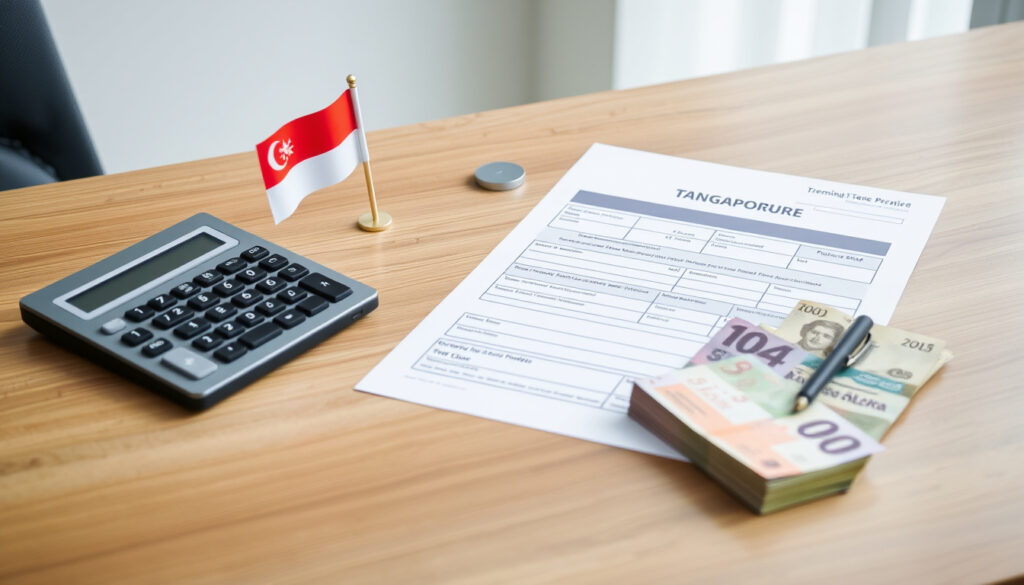
Singapore Personal Income Tax: Rates & Exemptions 2025
Few places spark as much curiosity about tax as Singapore, where low headline rates and a famously business-friendly system draw workers from around the world. Yet the actual numbers for individuals tell a nuanced story: a progressive system with seven brackets topping out at IRAS official rates (Singapore tax authority) on chargeable income above SGD 1,000,000, and a built-in tax-free zone for the first SGD 20,000.
Top marginal income tax rate: 24% ·
Tax-free threshold (resident): SGD 20,000 ·
Number of tax brackets: 7 ·
Highest bracket starts at: SGD 1,000,000 ·
Personal income tax rebate (YA 2025): 60% of tax payable, capped at SGD 200 ·
Corporate tax rate: 17%
Quick snapshot
- Progressive rates from 0% to 24% for residents (IRAS Individual Income Tax rates)
- Tax-free threshold of SGD 20,000 for residents (IRAS)
- Non-residents taxed at flat 15% or 22% on employment income (IRAS Sample calculations)
- No capital gains or inheritance tax (PwC Tax Summaries Singapore)
- Exact 2026 rates (official IRAS page dated Apr 2026 may reflect changes; check latest)
- Specific relief amounts may vary by individual circumstances
- 2025: Personal Income Tax Rebate of 60% (capped at SGD 200) applies for YA 2025 (IRAS)
- Next Budget (Feb 2026) may announce new rates or reliefs (IRAS)
- Watch for potential rate adjustments in 2026 Budget statement (IRAS Working in Singapore)
- Expats planning longer stays should confirm residency status early (IRAS Working in Singapore)
Six key indicators, one pattern: Singapore keeps its personal income tax low for most earners while reserving the top rate for incomes above SGD 1 million.
| Attribute | Value (YA 2025) |
|---|---|
| Year of Assessment | 2025 (current period) |
| Resident tax rate range | 0% – 24% |
| Non-resident employment income rate | 15% flat (or 22% if higher) |
| Tax-free chargeable income threshold | SGD 20,000 |
| Maximum personal relief cap | SGD 80,000 |
| Corporate tax rate (2025) | 17% |
Is Singapore heavily taxed?
Singapore tax burden compared globally
- Top marginal rate of 24% is among the lowest in developed Asia (IRAS)
- No capital gains tax, no inheritance tax, no estate duty (PwC Tax Summaries)
- Corporate tax rate at 17% further reduces overall tax burden for business owners
Countries like Denmark impose a top rate above 55%, while the UAE has 0% personal income tax. Singapore sits closer to the UAE end of the spectrum than to European welfare states.
Income tax rates overview
Residents face a progressive schedule with seven bands. The first SGD 20,000 is tax-free. The next SGD 10,000 is taxed at 2%, then 3.5%, 7%, 11.5%, and 15% for higher tiers, finally reaching 24% above SGD 1,000,000. Here is the full rate table from IRAS.
| Chargeable income (SGD) | Rate |
|---|---|
| First 20,000 | 0% |
| Next 10,000 | 2% |
| Next 10,000 | 3.5% |
| Next 40,000 | 7% |
| Next 40,000 | 11.5% |
| Next 80,000 | 15% |
| Above 200,000 to 1,000,000 | 18-22% (multiple sub-brackets) |
| Above 1,000,000 | 24% |
For a resident earning SGD 100,000 after reliefs, the effective tax rate hovers around 4-5% – far lower than in most OECD countries. The system is designed to keep talent and investment flowing without sacrificing basic progressivity.
The implication: Singapore’s tax burden is light for most earners, but high-income residents still pay a modest top rate that funds public services without scaring off wealth.
How much salary is taxable in Singapore?
Tax-free threshold for residents
Residents enjoy a SGD 20,000 tax-free allowance on chargeable income. Chargeable income is assessable income minus personal reliefs (e.g., CPF contributions, earned income relief, course fees relief). So even if your gross salary is SGD 30,000, after reliefs your chargeable income may fall below SGD 20,000, resulting in zero tax (IRAS).
Tax brackets and rates for residents
- 0% on first SGD 20,000
- 2% on next SGD 10,000
- 3.5% on next SGD 10,000
- 7% on next SGD 40,000
- 11.5% on next SGD 40,000
- 15% on next SGD 80,000
- 18-22% on income up to SGD 1,000,000
- 24% on income above SGD 1,000,000
The progressive structure means that high earners still keep the bulk of their income. A resident with SGD 250,000 gross income after reliefs pays about SGD 18,000 in tax – an effective rate of 7.2% (IRAS).
Taxable vs non-taxable income components
Employment income, bonuses, director fees, and most benefits-in-kind are taxable. Non-taxable items include capital gains, foreign-source income remitted to Singapore (for residents), gifts, and lottery winnings (PwC Tax Summaries).
How much tax will I pay if I earn $24000 a year?
Calculating tax on SGD 24,000 annual income
Assume a gross salary of SGD 24,000. Standard personal reliefs: earned income relief (SGD 1,000 for non-CPF members), CPF relief (if applicable). For a foreigner without CPF, assessable income = SGD 24,000. Chargeable income after earned income relief = SGD 23,000. Tax: first SGD 20,000 at 0%, next SGD 3,000 at 2% = SGD 60. After the YA 2025 Personal Income Tax Rebate of 60% (capped at SGD 200), net tax = SGD 24 (IRAS).
Impact of personal reliefs
- Earned income relief: up to SGD 1,000 for non-CPF members
- CPF relief for employees: up to SGD 20,400
- Other reliefs: course fees, life insurance, NSman – total cap SGD 80,000
With CPF contributions (20% employee share), a Singaporean earning SGD 24,000 would have chargeable income close to SGD 10,000 – resulting in zero tax.
Net tax payable after rebates
For YA 2025, the 60% rebate (capped at SGD 200) further reduces liability. Many low-income earners end up paying nothing. Use the IRAS tax calculator for an exact figure.
The trade-off: For earners at SGD 24,000, the effective tax rate is near zero – a deliberate policy to encourage workforce participation and keep consumption taxes neutral.
Do foreigners pay income tax in Singapore?
Tax residency rules
A foreigner becomes a tax resident if they stay or work in Singapore for at least 183 days in a calendar year, or under the three-year rule (continuous stay across two years with total 183 days). Directors, public entertainers, and certain professionals may be excluded (IRAS Working in Singapore).
Non-resident tax rates
- Employment income: flat 15% or resident rates (whichever yields higher tax)
- Director fees and certain other income: flat 24%
- Non-residents cannot claim personal reliefs (PwC Tax Summaries)
A non-resident earning SGD 100,000 would pay 15% flat = SGD 15,000, compared to a resident who might pay only SGD 4,500 after reliefs. That’s a steep penalty for short-term assignments.
Foreigner-specific reliefs and exemptions
Non-residents generally get no reliefs. However, if they qualify as residents (183-day rule), they become eligible for all reliefs retroactively. Foreign-sourced income remitted to Singapore is tax-free for residents but may be taxable for non-residents depending on source.
A foreigner arriving in May and leaving in December (240 days) would be resident and pay progressive rates. But one arriving in November and leaving in January (90 days) would be non-resident and face the 15% flat – a big difference for just a few days.
What this means: Employers planning short-term assignments must factor in the non-resident penalty. Stretching stays past 183 days, or using the three-year rule, can save thousands in tax.
What income is not taxed in Singapore?
Capital gains
Singapore does not tax capital gains. This includes profits from selling property, stocks, and other investments, as long as the seller is not considered a trader (PwC Tax Summaries).
Foreign-sourced income
Foreign-source income (e.g., dividends, interest, rental from overseas property) remitted to Singapore is generally tax-free for resident individuals. This makes Singapore attractive for expats with global portfolios.
Gifts and inheritances
Estate duty was abolished in 2008. Gifts received are not taxable. Lottery and sweepstakes winnings are also tax-free.
Related reading: If you’re also investing part of your income, check our guide on Singapore CPF Stocks Investment: Guide & Rules 2025 and the GST Voucher MediSave August 2025 for ways to offset living costs.
The pattern: Singapore deliberately excludes capital and foreign income from taxation to position itself as a wealth hub. The trade-off is a reliance on consumption taxes (GST) and corporate taxes for revenue.
Upsides
- Very low effective tax rates for most income levels
- No capital gains, inheritance, or estate taxes
- Generous personal reliefs and rebates (2025: 60% rebate cap SGD 200)
- Foreign-source income exemption for residents
- Simple filing system with pre-filled returns via IRAS
Downsides
- Non-residents pay high flat rates (15-24%) without reliefs
- Top marginal rate of 24% hits only above SGD 1M but still significant
- No deduction for mortgage interest (unlike some countries)
- Limited relief cap of SGD 80,000 may not fully cover high earners
Comparison: Singapore vs other tax-friendly jurisdictions
Three destinations, one contrast: Singapore offers a middle path between zero-tax havens and high-tax European states.
| Attribute | Singapore | Hong Kong | UAE |
|---|---|---|---|
| Top personal income tax rate | 24% | 17% | 0% |
| Capital gains tax | None | None | None |
| Inheritance/estate tax | None | None | None |
| Tax-free threshold | SGD 20,000 | HKD 132,000 | N/A |
| Non-resident rate | 15-24% | Progressive rates apply | 0% |
Singapore’s top rate of 24% is higher than Hong Kong’s 17% but comes with better infrastructure and a stable legal system. The UAE’s 0% is unbeatable, but expats there face a high cost of living and no path to citizenship.
“The current highest personal income tax rate is at 24%”
— IRAS, official tax rates page (Singapore tax authority)
“Resident individuals are subject to graduated tax rates ranging from 0% to 24%”
— PwC Singapore, global tax summary (PwC Tax Summaries)
For a young professional earning SGD 48,000, the decision between staying in Singapore or moving to Dubai is not just about tax: Singapore offers CPF savings, co-investment schemes, and a robust public healthcare system that the UAE lacks. The trade-off is a modest tax bill of around SGD 1,200 vs. zero – but with long-term benefits.
iras.gov.sg, iras.gov.sg, data.gov.sg, iras.gov.sg, taxesforexpats.com, expat.hsbc.com, iras.gov.sg, rikvin.com, iras.gov.sg, rsbu.sg
Frequently asked questions
What is the personal income tax rebate for YA 2025?
Residents received a 60% rebate on tax payable, capped at SGD 200. This was announced in Budget 2024 and posted on IRAS rates page.
How do I file my income tax in Singapore?
File online via IRAS myTax Portal. Most employees receive pre-filled returns. Deadline is 15 April (paper) or 18 April (e-filing). Use IRAS calculators to estimate.
What is the tax residency rule in Singapore?
You are resident if you stay 183 days or more in a calendar year, or under the three-year rule (at least 183 days across two consecutive years). IRAS residency guide.
Are capital gains taxed in Singapore?
No. Capital gains from property, stocks, and other investments are not taxed unless you are considered a trader. PwC confirms this.
What is the maximum personal relief I can claim?
Total personal reliefs are capped at SGD 80,000 per year (excluding CPF relief). IRAS tax reliefs page.
Do I need to file taxes if I earn less than SGD 20,000?
If your chargeable income (after reliefs) is below SGD 20,000, you normally do not need to file. But if tax was deducted at source, filing may be required for a refund.
How is foreign income taxed in Singapore?
Foreign-sourced income remitted to Singapore by resident individuals is generally tax-free. Non-residents may be taxed.
More related posts
 Viagra in Mustafa Singapore: Where to Buy, Effects & Safety
 CPF Contribution Ceiling 2025: Ordinary Wage & Annual Cap
 S&P 500 Index Fund Investing: Returns and Buffett’s Pick
 Best Travel Apps for Planning: Route Planners & AI Tools
 Flamengo vs Bayern Munich Lineups: Confirmed XI & Score
 Great Eastern Travel Insurance: Claims and Coverage Guide
 How to Book Tiket Kereta Api Online: KAI Access, Traveloka
 Bangladesh Women vs Australia Women: Head-to-Head Records