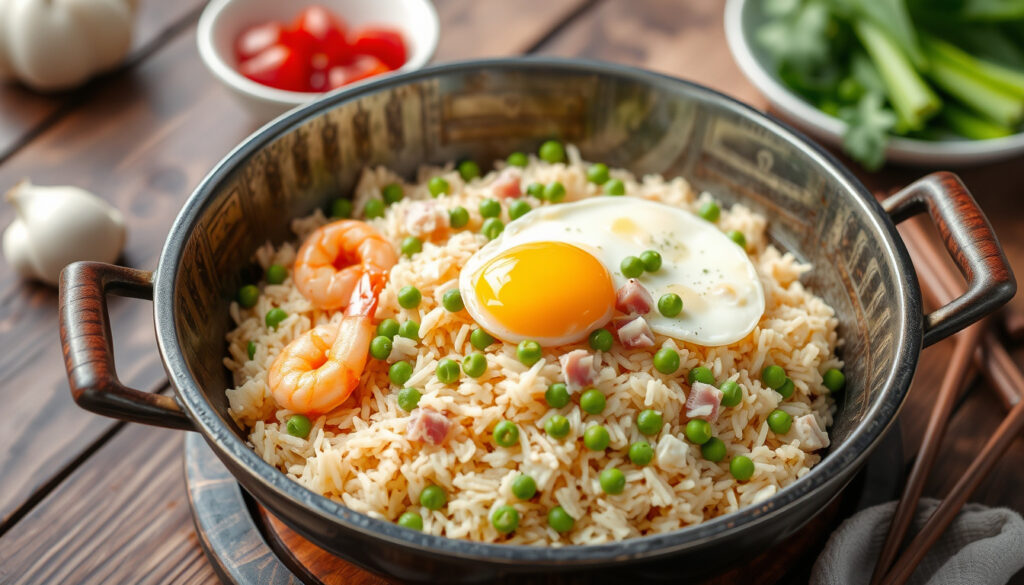
Yangzhou Fried Rice Guide: History, Ingredients, Recipe
Anyone who has ever ordered fried rice from a Chinese takeout menu knows there are dozens of varieties — but one dish consistently appears above the rest. Yangzhou fried rice, sometimes called Yang Chow fried rice, isn’t just another egg-fried rice; it’s a wok masterpiece with a surprisingly complicated legal history, an official government standard, and a recipe that still leaves room for home cooks.
Origin: Late 19th century, Qing dynasty ·
Official standard: Issued by Yangzhou city government in 2015 ·
Typical ingredients: Shrimp, pork, egg, mushrooms, peas, carrots, day-old rice ·
Cooking time: 15–20 minutes
Quick snapshot
- Originated in Yangzhou, Jiangsu province during the late Qing dynasty (China Today)
- Official standard published by Yangzhou Bureau of Quality and Technical Supervision in 2015 (Panda Cheffy on Medium)
- Core ingredients: day-old rice, eggs, shrimp, pork, mixed vegetables (Made With Lau)
- Traditionally not spicy — relies on savory umami (RNZ Recipes)
- Exact date of origin — most sources say “late 19th century” without a specific year (China Today) (Cooks Without Borders)
- Whether the original recipe included ham or relied on pork alone (Cooks Without Borders)
- Regional variations across Chinese diaspora make a single “authentic” recipe hard to pin down (RNZ Recipes) (Cooks Without Borders)
- Late 19th century: Dish originates in Yangzhou during the Qing dynasty (China Today)
- 1950s: Grows popular in Hong Kong and international Chinese restaurants (Made With Lau)
- October 2015: Yangzhou city government issues official standard for ingredients and preparation (Panda Cheffy on Medium)
- Home cooks continue adapting the dish with local ingredients (Adam Liaw)
- Government standard may influence restaurant labeling and menu descriptions in China (China Today) (Adam Liaw)
- Diaspora versions will likely keep diverging from the official recipe (RNZ Recipes) (Adam Liaw)
The attributes below put the dish’s government-backed profile into a single view.
| Attribute | Details |
|---|---|
| Origin | Yangzhou, Jiangsu, China |
| Cuisine | Jiangsu |
| Main ingredients | Rice, egg, shrimp, pork, vegetables |
| Cooking method | Wok-fried |
| Spicy (traditional) | No |
| Official recognition | Standardized by Yangzhou government in 2015 |
What is Yangzhou fried rice?
Yangzhou fried rice is a classic Chinese wok-fried rice dish from Jiangsu province. It typically includes egg, shrimp, pork, and mixed vegetables, and is known for its fluffy texture and savory flavor. The dish is often described as a “deluxe” fried rice because it combines multiple proteins and vegetables in one wok (Chowmi).
What is Yang Chou style fried rice?
Yang Chou style fried rice is the Cantonese romanization of Yangzhou fried rice. It refers to the same dish, popularized in Hong Kong and overseas Chinese restaurants from the 1950s onward (Made With Lau). The key difference is that the Cantonese version often uses char siu (barbecue pork) and is slightly sweeter than the Jiangsu original.
What is Yang Zhu fried rice?
Yang Zhu fried rice is a common misspelling or transliteration variation of Yangzhou fried rice. Some English-language menus also use “Yang Chow” or “Yeung Chow” — all pointing to the same dish (RNZ Recipes).
The pattern: a single dish name now covers everything from a takeout staple to a government-defined recipe.
What is the difference between fried rice and Yangzhou fried rice?
Not all fried rice is created equal. Yangzhou fried rice stands out because of its specific ingredient list and cooking philosophy.
Yangzhou fried rice vs fried rice
Standard egg fried rice typically uses egg, rice, scallions, and soy sauce. Yangzhou fried rice goes further: it includes shrimp, pork, Chinese ham, mushrooms, peas, carrots, and bamboo shoots (Cooks Without Borders).
What makes Yangzhou fried rice unique?
Three things separate it from the pack:
- Higher protein-to-rice ratio — multiple meats and seafood in every bite (Adam Liaw)
- Lighter, less saucy texture — no heavy soy sauce coating (Made With Lau)
- Separate cooking of ingredients — each component is fried individually before combining (RNZ Recipes)
Set side by side, the two fried rice styles diverge on protein depth, vegetable mix, and sauce weight.
| Feature | Standard Fried Rice | Yangzhou Fried Rice |
|---|---|---|
| Proteins | Egg only, or egg + one meat | Shrimp, pork, ham, egg |
| Vegetables | Scallions, maybe peas | Peas, carrots, bamboo shoots, mushrooms |
| Sauce | Heavy soy sauce | Light soy + sesame oil |
Home cooks face a real choice: the authentic Yangzhou method requires prepping and wok-frying each ingredient separately — about 15-20 minutes of active cooking. Standard fried rice takes half that time. The payoff is a dish where every component keeps its own texture.
The implication: choose the longer method only when you want the layered texture; otherwise the quick version wins on speed.
Why is Yangzhou fried rice so famous?
Yangzhou fried rice didn’t become famous by accident. Its rise from a regional specialty to a global icon follows a clear trajectory — and a surprising government intervention.
What is the history of Yangzhou fried rice?
Yangzhou fried rice originated in the late 19th century during China’s Qing dynasty, in the city of Yangzhou, Jiangsu province (China Today). It gained international popularity in the 1950s when Cantonese-style Chinese restaurants in Hong Kong began serving it to Western tourists (Made With Lau).
Why is it considered a classic Chinese dish?
In 2015, the Yangzhou Bureau of Quality and Technical Supervision released an official standard for the dish (Panda Cheffy on Medium). The standard specifies exact ingredients and proportions, making Yangzhou fried rice one of the few Chinese dishes with a legally recognized recipe. Official ingredients include Indica rice, fresh eggs, sea cucumber, cooked chicken thigh, Chinese ham, scallop, lake shrimp, mushroom, bamboo shoot, and peas (China Today).
What this means: authenticity has now been codified on paper, even as everyday kitchens continue to adapt it.
What are the essential ingredients of Yangzhou fried rice?
The ingredient list for Yangzhou fried rice varies from kitchen to kitchen, but a core set of components appears in almost every reputable recipe.
- Day-old rice — jasmine or Indica rice, cooked and cooled to prevent clumping (Made With Lau)
- Eggs — scrambled separately and broken into small pieces
- Shrimp — lake shrimp or small prawns (China Today)
- Pork — roasted or barbecued pork (char siu) or Chinese ham (Made With Lau)
- Vegetables — peas, carrots, bamboo shoots, mushrooms (Cooks Without Borders)
- Seasonings — soy sauce, sesame oil, white pepper, scallions (RNZ Recipes)
What meat is in Yangzhou fried rice?
Most versions include shrimp and some form of pork — typically roasted pork or Chinese ham. The official standard adds sea cucumber, scallop, and chicken thigh as optional but traditional inclusions (China Today). Some home cooks substitute char siu with ham or omit the pork entirely for a seafood version (The Mini Chef).
What vegetables are used in Yangzhou fried rice?
Peas and carrots are the most common vegetables. The official standard includes mushrooms and bamboo shoots (China Today). Cooks Without Borders adds shiitake mushrooms and edamame as alternatives to peas (Cooks Without Borders).
The official government standard includes luxury ingredients like sea cucumber and scallop that most home cooks don’t keep in the fridge. For a practical weekday version, skip those and stick with shrimp + pork + egg — you’ll still produce a recognized Yangzhou-style dish.
The implication: a home cook can stay true to the dish without buying the luxury list — the core formula carries the identity.
How to make authentic Yangzhou fried rice?
Making Yangzhou fried rice at home is entirely achievable with a wok and a hot burner. The technique matters as much as the ingredients.
What is the proper technique for making Yangzhou fried rice?
- Prepare the rice: Use day-old jasmine or Indica rice. If using fresh rice, spread it on a tray and cool for 30 minutes (Made With Lau).
- Prep all ingredients: Dice the pork, ham, carrots, bamboo shoots, and mushrooms into uniform small cubes. Beat the eggs.
- Wok hei heat: Heat your wok over high heat until it smokes. Add oil, then scramble the eggs — remove them after 30 seconds (Adam Liaw).
- Cook aromatics: Fry scallions, ginger, and garlic briefly.
- Proteins first: Fry the shrimp and pork until cooked through, then remove.
- Vegetables: Stir-fry carrots, peas, mushrooms, and bamboo shoots for 1-2 minutes.
- Rice: Add the rice to the wok, spreading it over the surface to heat without steaming.
- Combine, season, and finish: Return all cooked ingredients to the wok. Add soy sauce, sesame oil, and white pepper. Toss vigorously for 30-60 seconds, then toss in fresh scallions and serve immediately (RNZ Recipes).
Best Yang Chow fried rice recipe
For the most reliable home-cook version, combine day-old jasmine rice, 2 eggs, 4 oz shrimp, 4 oz roasted pork, ½ cup mixed peas and carrots, ¼ cup diced bamboo shoots, 2 tbsp light soy sauce, and 1 tsp sesame oil. Cook on high heat in a wok (Cooks Without Borders).
The implication: technique beats rare ingredients; master the day-old rice and hot wok and the dish will read as Yangzhou-style.
Is Yangzhou fried rice spicy?
No — traditional Yangzhou fried rice is not spicy. It relies on savory umami from the proteins, soy sauce, and sesame oil rather than any chili heat (RNZ Recipes).
Does Yangzhou fried rice contain chili?
Traditional versions contain no chili or chili oil. The flavor profile is mild and balanced, letting the natural flavors of the ingredients shine (Made With Lau).
Can you make it spicy?
Absolutely — some modern adaptations add sriracha, chili oil, or fresh chili peppers for heat. 2foodtrippers includes optional sriracha and MSG in their version (2foodtrippers). This is not traditional, but it’s a common fusion variation.
If you’re expecting the fiery heat of Szechuan or Hunan cuisine, Yangzhou fried rice will surprise you with its restraint. For cooks who want heat: add chili at the end, not during the wok-fry, so the spice doesn’t overpower the delicate balance of the dish.
Confirmed facts
- Yangzhou fried rice is a dish from Jiangsu province (China Today)
- It contains shrimp, pork, egg, and vegetables (Made With Lau)
- The government issued a standard in 2015 (Panda Cheffy on Medium)
- Traditionally not spicy (RNZ Recipes)
What’s unclear
- Exact date of origin
- Whether the original recipe included ham or pork
- How much the regional diaspora versions vary from the official standard
- Whether day-old rice is strictly required or simply preferred
“Yangzhou fried rice is a classic Chinese wok-fried rice dish from Jiangsu province, typically including egg, shrimp, pork, and mixed vegetables.”
“The standard recipe described by China Today includes Indica rice, fresh eggs, sea cucumber, cooked chicken thigh, Chinese ham, scallop, lake shrimp, mushroom, bamboo shoot, and peas.”
The pattern that emerges from all this: Yangzhou fried rice is both a specific government-standardized recipe and a flexible home-cook canvas. For the cook, the choice is clear: follow the core ingredients and technique, skip the luxury add-ons, and produce a dish that honors the tradition without requiring a trip to a specialty seafood market.
Related reading: Yangzhou fried rice authentic preparation and history · Yangzhou fried rice official government standard and ingredients
For a deeper look at the dish’s history and regional variations, see this guide on Yung Chow fried rice origins.
Frequently asked questions
Can I use leftover rice for Yangzhou fried rice?
Yes — leftover rice is actually preferred. Day-old rice that has been refrigerated overnight is drier and separates more easily during wok-frying, preventing the clumpy texture that fresh rice can produce (Made With Lau).
What is the best type of rice to use?
Jasmine rice or Indica rice works best. Long-grain varieties give the dish its signature fluffy, separate-grain texture. Sticky or short-grain rice will produce a denser result (RNZ Recipes).
Can I make Yangzhou fried rice vegetarian?
Yes — substitute the shrimp and pork with pressed tofu, mushrooms, or mock duck. The key is maintaining the savory umami through soy sauce, sesame oil, and mushrooms (Cooks Without Borders).
How do I reheat Yangzhou fried rice without drying it out?
Reheat in a wok or skillet over medium-high heat with a splash of water or chicken stock. Cover for 1-2 minutes to steam, then uncover and toss to restore the wok-fried texture. Avoid microwave reheating, which dries out the grains (Adam Liaw).
Is Yangzhou fried rice gluten-free?
Traditional versions use soy sauce, which contains wheat and is not gluten-free. For a gluten-free version, substitute tamari or coconut aminos for the soy sauce and verify that all other ingredients (especially oyster sauce and char siu) are gluten-free (2foodtrippers).
What is the difference between Yangzhou fried rice and Singapore fried rice?
Singapore fried rice is a Southeast Asian variation that includes curry powder, giving it a yellow color and spicier flavor. Yangzhou fried rice relies on savory umami, not curry. Singapore fried rice also typically includes chicken and shrimp with less emphasis on Chinese ham or pork (RNZ Recipes).
The bottom line for anyone ordering or cooking: the name carries a standard, but the best versions respect the core technique.
More related posts
 Career Fair Singapore 2025: Dates, Dress Code, and Job Market
 Jurong East ActiveSG Gym: Hours, Fees & Membership Guide
 Ruhens SG Ubi: Korean Tankless Water Dispenser Guide
 Motorbike Shop Near Me: Best Dealers in Ireland
 Bugis BBQ and Hotpot: Menu, Prices & Reservations Guide
 Singapore Zoo Ticket Price 2025: Official Rates & Discounts
 Functional Training Near Orchard Rd for Beginners: Costs & Guide
 Nearest Polyclinic Singapore: Walk-In, Costs & Hours